
The False Sense
of Agency
What crypto bros and bhajan-jammers have in common and why neither works.
Six months into my ride across India learning yoga and philosophy, I felt exactly as empty as the day after CreditVidya's exit. Money hadn't fixed my hollowness. Meditation wasn't fixing it either. That's when I realised I was doing the same thing as the guy day-trading memecoins between gym sets. He was chasing variance to feel like he had control over his life. I was chasing detachment to feel like I'd transcended needing control.
Here's what's happening to you right now:
Your best friend just told you he's terrified AI will take his job. He's not wrong—1 in 2 people in your generation share that fear. You haven't made a real new friend in two years because every interaction goes through a filter, a match, or an algorithm. You can't even remember the last time you made a choice that wasn't suggested by Netflix, Bumble, Zomato, Spotify, or some other feed.
So you do one of two things:
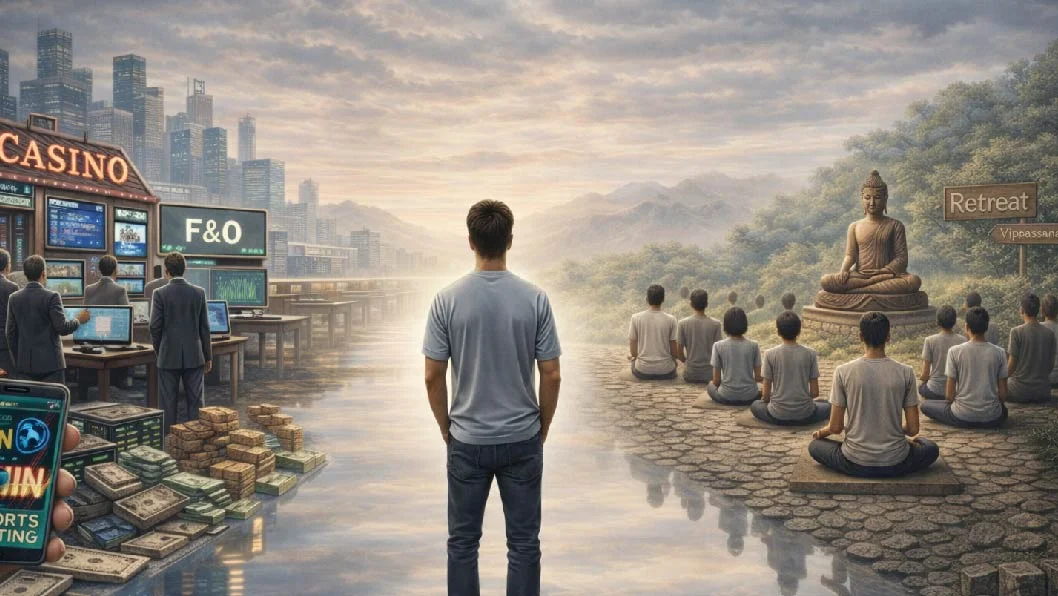
You bet. You trade F&O with money you can't afford to lose. You buy the memecoin. Because for the 4 seconds between placing the bet and seeing the result, you feel like you matter. You feel like a cause, not an effect.
Or you retreat. You sign up for the 10-day Vipassana. You post sunrise photos with Sanskrit captions. You tell yourself you're "above material success" when really you're terrified of trying and failing publicly.
The data confirms this split. Sports betting revenue has surged 5,500% since 2017. Simultaneously, the meditation app market has hit $4.2 billion.
These look like contradictory trends, but they're not. Different doors. Same building.

The Death of Agency
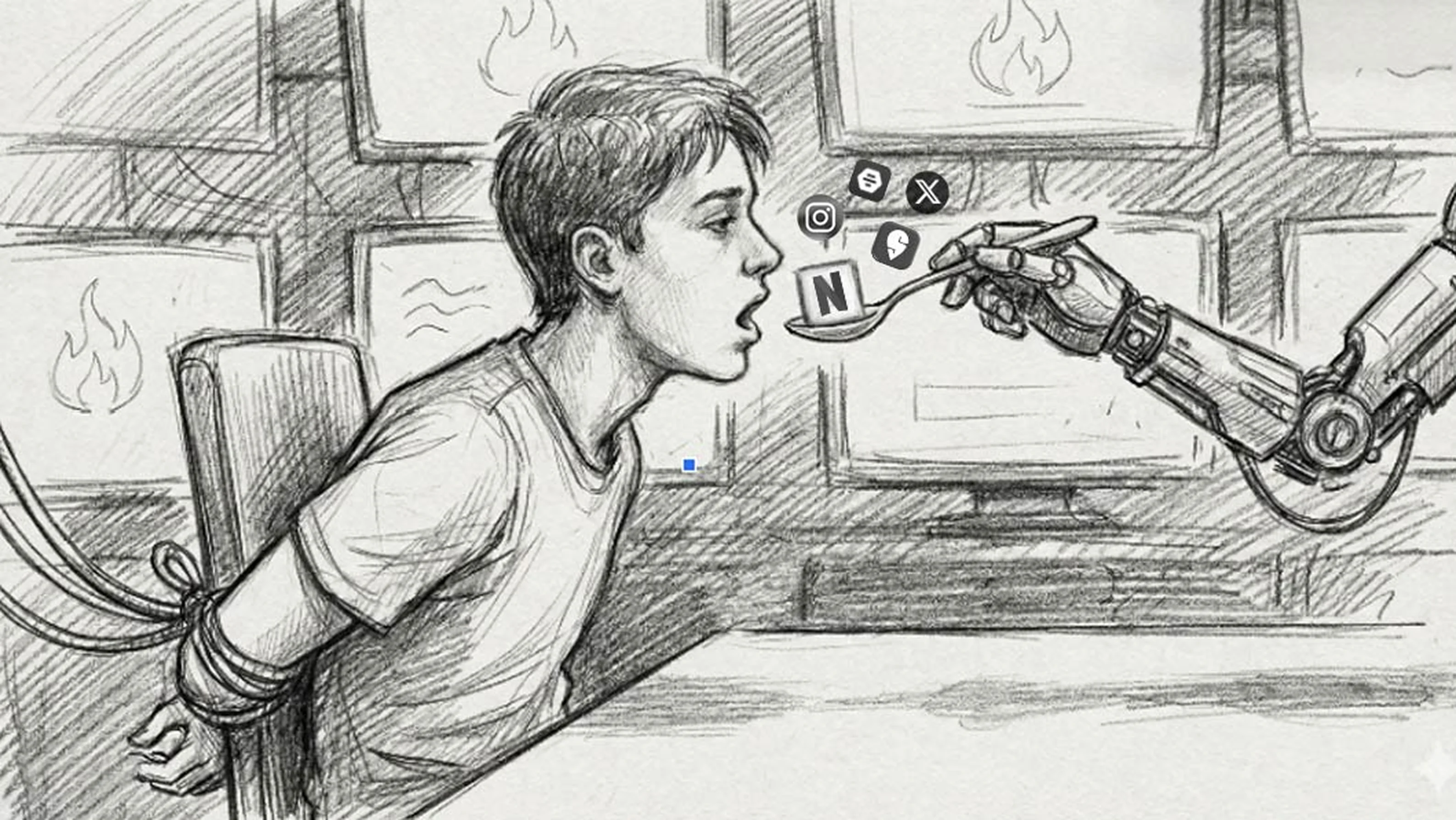
We now have a generation whose path to agency - the biological drive to control your own life - has been systematically destroyed by algorithms, AI, and social media. The result? A mass split into two camps that look like opposites, but are actually seeking the same thing.
Long Degeneracy camp: Gambling, memecoins, high-variance bets to simulate the feeling of control.
Long God camp: Meditation apps, yoga certifications, and spiritual performance to simulate transcending the need for control.
One leads to the casino, the other to the monastery, but both offer the same thing: the feeling that you're choosing your path when you're actually avoiding having to forge one.
Having experienced both, I chose a third path - writing. Not because it's superior, but because it allows me to sit with the discomfort of not knowing if I'm doing it right.
How We Lost the Courage to Climb
Maslow warned us about this 80 years ago. He predicted that if we ever solved hunger and shelter, we wouldn't get utopia. We’d get a "new discontent” unless individuals were doing what they were "fitted for."
His conclusion was stark: "What a man can be, he must be."
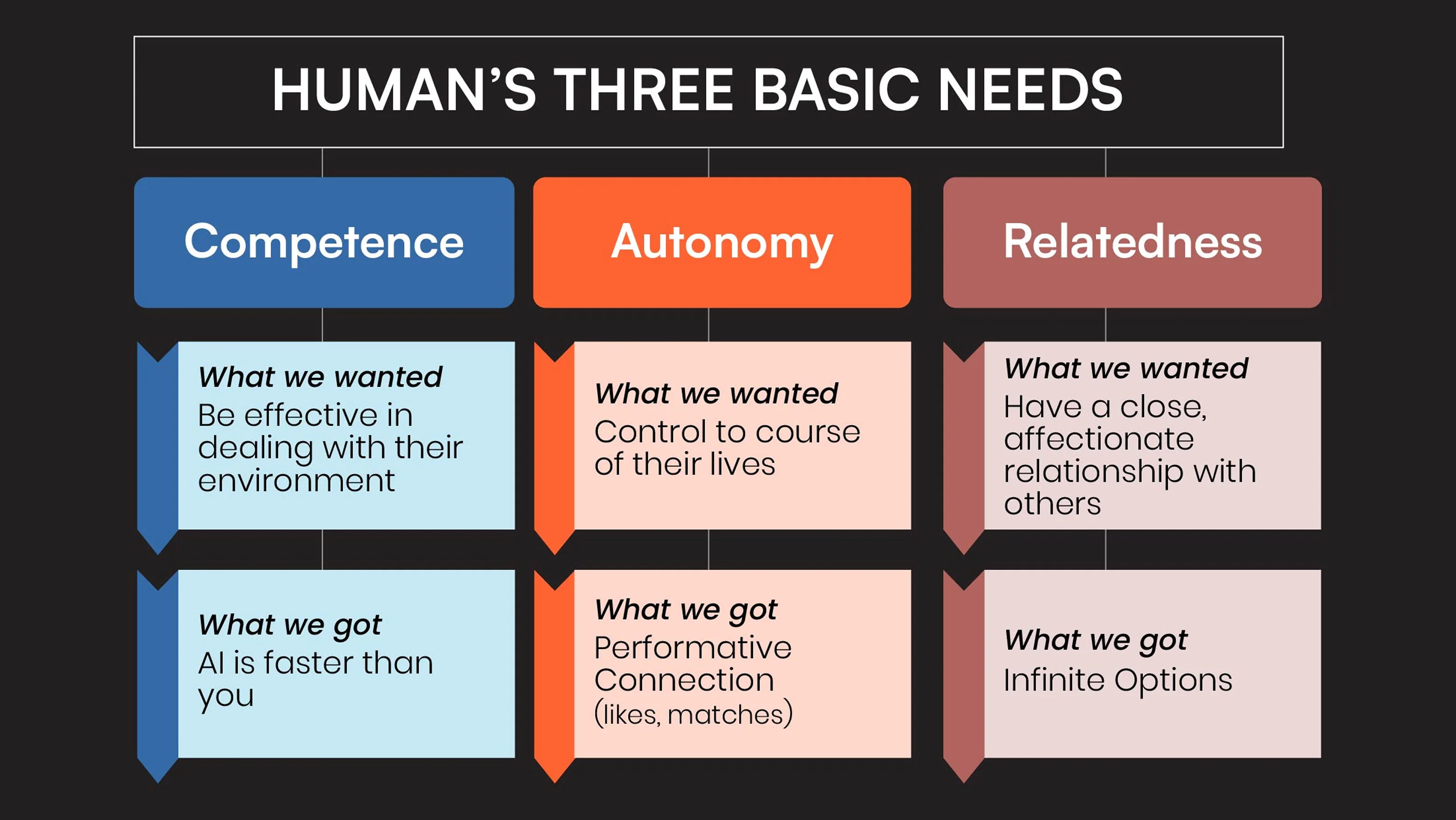
Psychology gives us a framework called Self-Determination Theory (SDT). It argues that once you are fed, you need three "nutrients" to stay sane: Autonomy (control), Competence (mastery), and Relatedness (connection).
In the last decade, we haven't just blocked these needs; we have inverted them into anxieties. We wanted agency, but we got fear.
- The Death of Competence (Fear of Obsolescence) We used to believe that if you put in 10,000 hours, you would master a skill and secure your future. That contract is broken. Just as Gen Z entered the workforce, AI arrived to threaten their utility and dissolved the path to competence. The result is a Rational Fear of Obsolescence. 52% of Gen Z now fear being replaced by someone with superior AI skills.
- The Death of Relatedness (Fear of Intimacy) We have traded the messiness of community for the safety of connectivity. We are terrified of the friction of real life, so we retreat to the algorithmic safety of Hinge and Raya. We don't meet people; we filter profiles. We have replaced the risk of connection with the assurance of a match. But this safety comes at a cost: we get the metric of relatedness (a match, a like) without the nutrient of presence.
- The Death of Autonomy (Fear of Choice) We claim we want freedom, but true freedom is terrifying. It requires taking responsibility for outcomes. To cope, we have outsourced our volition to the "Black Box." Over 70% of what a young person watches on YouTube is chosen by an algorithm. We let Spotify choose the music, Netflix choose the shows, and Bumble choose the date. We have developed a Learned Helplessness. We are no longer explorers of our lives but passengers in a digital vehicle we do not know how to steer.
What crypto bros and bhajan-jammers have in common and why neither works.
Six months into my ride across India learning yoga and philosophy, I felt exactly as empty as the day after CreditVidya's exit. Money hadn't fixed my hollowness. Meditation wasn't fixing it either. That's when I realised I was doing the same thing as the guy day-trading memecoins between gym sets. He was chasing variance to feel like he had control over his life. I was chasing detachment to feel like I'd transcended needing control.
Here's what's happening to you right now:
Your best friend just told you he's terrified AI will take his job. He's not wrong—1 in 2 people in your generation share that fear. You haven't made a real new friend in two years because every interaction goes through a filter, a match, or an algorithm. You can't even remember the last time you made a choice that wasn't suggested by Netflix, Bumble, Zomato, Spotify, or some other feed.
So you do one of two things:
You bet. You trade F&O with money you can't afford to lose. You buy the memecoin. Because for the 4 seconds between placing the bet and seeing the result, you feel like you matter. You feel like a cause, not an effect.
Or you retreat. You sign up for the 10-day Vipassana. You post sunrise photos with Sanskrit captions. You tell yourself you're "above material success" when really you're terrified of trying and failing publicly.
The data confirms this split. Sports betting revenue has surged 5,500% since 2017. Simultaneously, the meditation app market has hit $4.2 billion.
These look like contradictory trends, but they're not. Different doors. Same building.
The Death of Agency
We now have a generation whose path to agency - the biological drive to control your own life - has been systematically destroyed by algorithms, AI, and social media. The result? A mass split into two camps that look like opposites, but are actually seeking the same thing.
Long Degeneracy camp: Gambling, memecoins, high-variance bets to simulate the feeling of control.
Long God camp: Meditation apps, yoga certifications, and spiritual performance to simulate transcending the need for control.
One leads to the casino, the other to the monastery, but both offer the same thing: the feeling that you're choosing your path when you're actually avoiding having to forge one.
Having experienced both, I chose a third path - writing. Not because it's superior, but because it allows me to sit with the discomfort of not knowing if I'm doing it right.
How We Lost the Courage to Climb
Maslow warned us about this 80 years ago. He predicted that if we ever solved hunger and shelter, we wouldn't get utopia. We’d get a "new discontent” unless individuals were doing what they were "fitted for."
His conclusion was stark: "What a man can be, he must be."
Psychology gives us a framework called Self-Determination Theory (SDT). It argues that once you are fed, you need three "nutrients" to stay sane: Autonomy (control), Competence (mastery), and Relatedness (connection).
In the last decade, we haven't just blocked these needs; we have inverted them into anxieties. We wanted agency, but we got fear.
- The Death of Competence (Fear of Obsolescence) We used to believe that if you put in 10,000 hours, you would master a skill and secure your future. That contract is broken. Just as Gen Z entered the workforce, AI arrived to threaten their utility and dissolved the path to competence. The result is a Rational Fear of Obsolescence. 52% of Gen Z now fear being replaced by someone with superior AI skills.
- The Death of Relatedness (Fear of Intimacy) We have traded the messiness of community for the safety of connectivity. We are terrified of the friction of real life, so we retreat to the algorithmic safety of Hinge and Raya. We don't meet people; we filter profiles. We have replaced the risk of connection with the assurance of a match. But this safety comes at a cost: we get the metric of relatedness (a match, a like) without the nutrient of presence.
- The Death of Autonomy (Fear of Choice) We claim we want freedom, but true freedom is terrifying. It requires taking responsibility for outcomes. To cope, we have outsourced our volition to the "Black Box." Over 70% of what a young person watches on YouTube is chosen by an algorithm. We let Spotify choose the music, Netflix choose the shows, and Bumble choose the date. We have developed a Learned Helplessness. We are no longer explorers of our lives but passengers in a digital vehicle we do not know how to steer.
The False Sense
of Agency
What crypto bros and bhajan-jammers have in common and why neither works.
Six months into my ride across India learning yoga and philosophy, I felt exactly as empty as the day after CreditVidya's exit. Money hadn't fixed my hollowness. Meditation wasn't fixing it either. That's when I realised I was doing the same thing as the guy day-trading memecoins between gym sets. He was chasing variance to feel like he had control over his life. I was chasing detachment to feel like I'd transcended needing control.
Here's what's happening to you right now:
Your best friend just told you he's terrified AI will take his job. He's not wrong—1 in 2 people in your generation share that fear. You haven't made a real new friend in two years because every interaction goes through a filter, a match, or an algorithm. You can't even remember the last time you made a choice that wasn't suggested by Netflix, Bumble, Zomato, Spotify, or some other feed.
So you do one of two things:
You bet. You trade F&O with money you can't afford to lose. You buy the memecoin. Because for the 4 seconds between placing the bet and seeing the result, you feel like you matter. You feel like a cause, not an effect.
Or you retreat. You sign up for the 10-day Vipassana. You post sunrise photos with Sanskrit captions. You tell yourself you're "above material success" when really you're terrified of trying and failing publicly.
The data confirms this split. Sports betting revenue has surged 5,500% since 2017. Simultaneously, the meditation app market has hit $4.2 billion.
These look like contradictory trends, but they're not. Different doors. Same building.
The Death of Agency
We now have a generation whose path to agency - the biological drive to control your own life - has been systematically destroyed by algorithms, AI, and social media. The result? A mass split into two camps that look like opposites, but are actually seeking the same thing.
Long Degeneracy camp: Gambling, memecoins, high-variance bets to simulate the feeling of control.
Long God camp: Meditation apps, yoga certifications, and spiritual performance to simulate transcending the need for control.
One leads to the casino, the other to the monastery, but both offer the same thing: the feeling that you're choosing your path when you're actually avoiding having to forge one.
Having experienced both, I chose a third path - writing. Not because it's superior, but because it allows me to sit with the discomfort of not knowing if I'm doing it right.
How We Lost the Courage to Climb
Maslow warned us about this 80 years ago. He predicted that if we ever solved hunger and shelter, we wouldn't get utopia. We’d get a "new discontent” unless individuals were doing what they were "fitted for."
His conclusion was stark: "What a man can be, he must be."
Psychology gives us a framework called Self-Determination Theory (SDT). It argues that once you are fed, you need three "nutrients" to stay sane: Autonomy (control), Competence (mastery), and Relatedness (connection).
In the last decade, we haven't just blocked these needs; we have inverted them into anxieties. We wanted agency, but we got fear.
- The Death of Competence (Fear of Obsolescence) We used to believe that if you put in 10,000 hours, you would master a skill and secure your future. That contract is broken. Just as Gen Z entered the workforce, AI arrived to threaten their utility and dissolved the path to competence. The result is a Rational Fear of Obsolescence. 52% of Gen Z now fear being replaced by someone with superior AI skills.
- The Death of Relatedness (Fear of Intimacy) We have traded the messiness of community for the safety of connectivity. We are terrified of the friction of real life, so we retreat to the algorithmic safety of Hinge and Raya. We don't meet people; we filter profiles. We have replaced the risk of connection with the assurance of a match. But this safety comes at a cost: we get the metric of relatedness (a match, a like) without the nutrient of presence.
- The Death of Autonomy (Fear of Choice) We claim we want freedom, but true freedom is terrifying. It requires taking responsibility for outcomes. To cope, we have outsourced our volition to the "Black Box." Over 70% of what a young person watches on YouTube is chosen by an algorithm. We let Spotify choose the music, Netflix choose the shows, and Bumble choose the date. We have developed a Learned Helplessness. We are no longer explorers of our lives but passengers in a digital vehicle we do not know how to steer.

Resonating with this philosophy?
Join the smartest founders mastering the inner game to face the unknown. Read by YC & Sequoia.
The Two Shortcuts
When building agency feels impossible, we look for shortcuts to feel something similar.
Long Degeneracy: The Casino as a Sanctuary
When you feel obsolete and powerless, "slow and steady" feels like a scam. If you can't build a career because of AI, and you can't build a life because of housing costs, you stop trying to climb. You start trying to jump.
You turn to Variance.
The logic: One big score changes everything. One lucky trade and you're free. The math doesn't matter. The feeling of agency does.
That explains the explosion in gambling, betting, F&O trading, etc. This isn't greed but a desperate attempt to feel in control.
The Casino is the only place left where a young person feels like a protagonist. Till the moment the wheel is spinning, they are a Cause, not an Effect.
Long God: The Fortress of Solitude
If "Long Degeneracy" seeks to overcome fear through high-risk action, "Long God" seeks to overcome it through high-level detachment.
We are seeing a massive boom in "spiritual" and wellness practices, with 65-77% of Gen Z now identifying as "spiritual".
This is the strategy of Surrender.
The logic: If I can't control outcomes, I'll control my need for outcomes. I'll declare myself above the game.
What it offers: Identity protection as detachment becomes an achievement.
What it costs: If you're using meditation to build capacity for difficult work - to sit with discomfort, to clarify direction - that's genuine practice. But if "I'm above material success" really means "I'm afraid to try and fail publicly," you're not self-actualising. You're spiritually bypassing.
The monastery lets you feel like you've transcended the need to become what you're capable of becoming, without doing the terrifying work of forging your path.
The Mirror Image
The casino says: "I can't build real agency, so I'll simulate control through variance."
The monastery says: "I can't build real agency, so I'll claim I've transcended needing it."
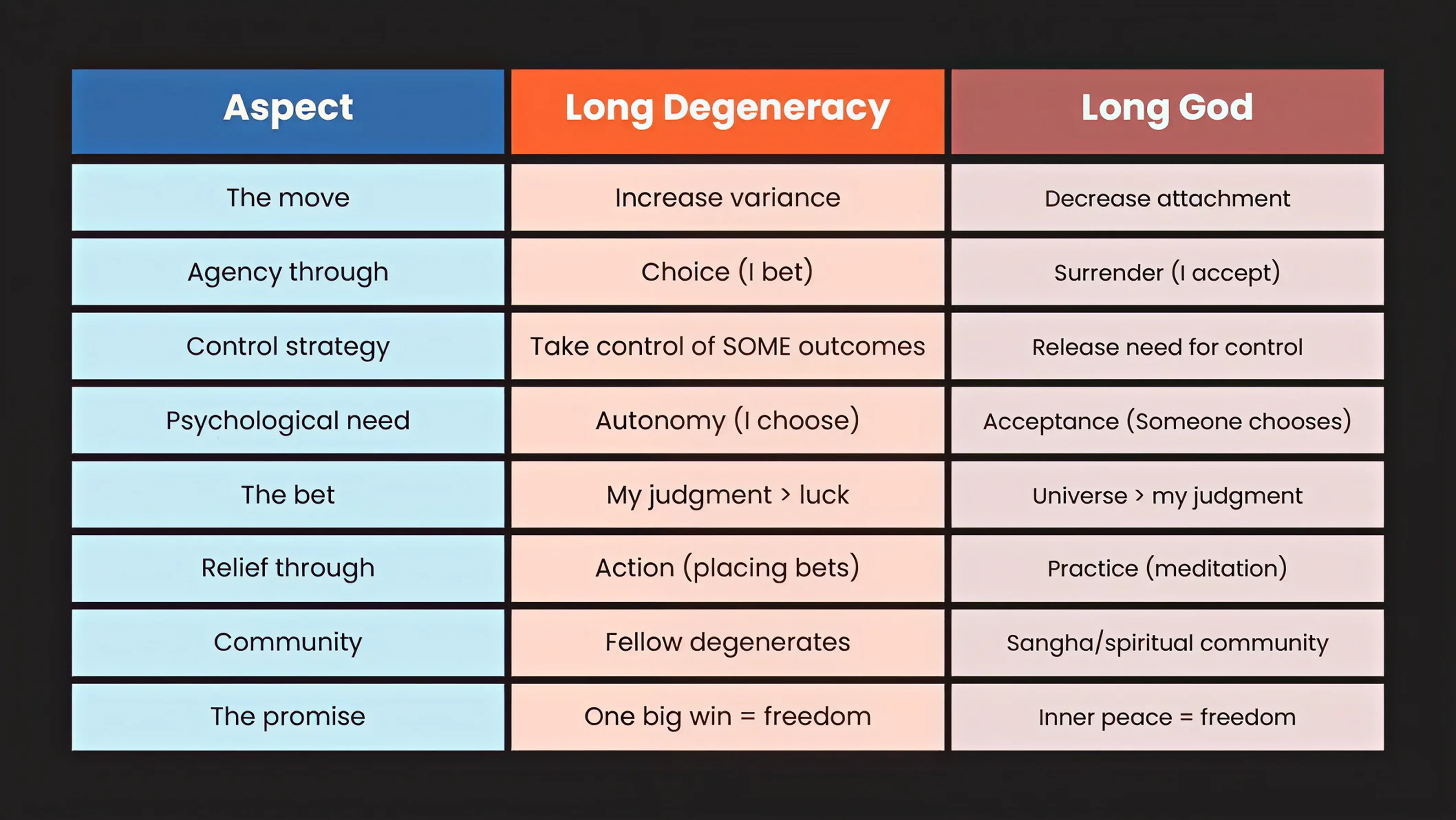
Both protect you from the biological imperative: What you can be, you must be.
The Hard Path
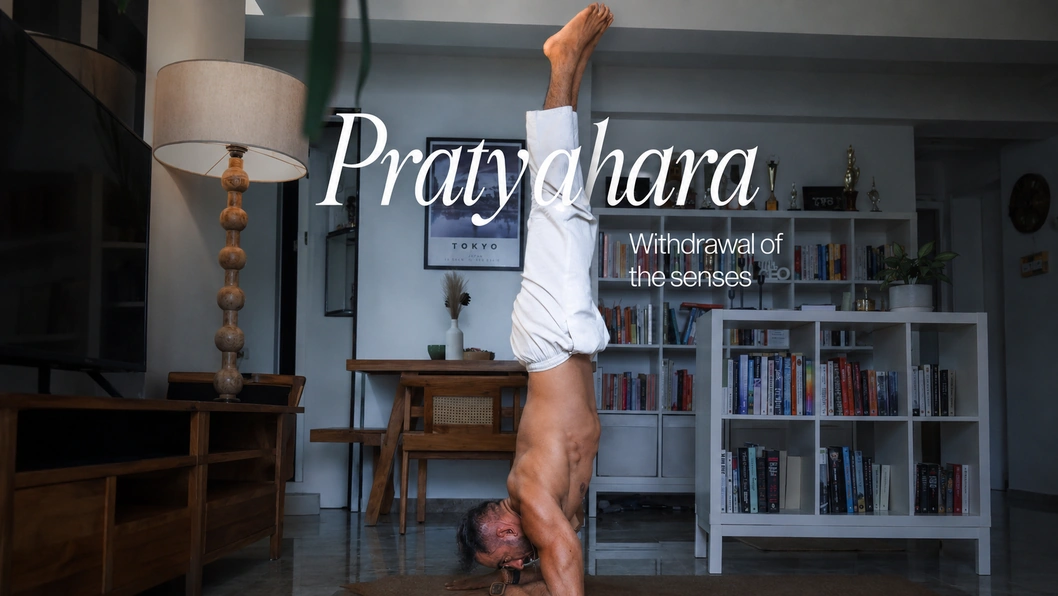
In the ancient texts I was studying, there is a concept that predates Maslow by a few thousand years: Swadharma. It is the specific, messy, difficult path that is unique to you. The texts contain a harsh warning: It is better to die in your own Swadharma than to do another’s well.
Here's what stops you: Comfort.
The casino is comfortable because variance creates stimulation without sustained effort.
The monastery is comfortable because detachment provides identity without public risk.
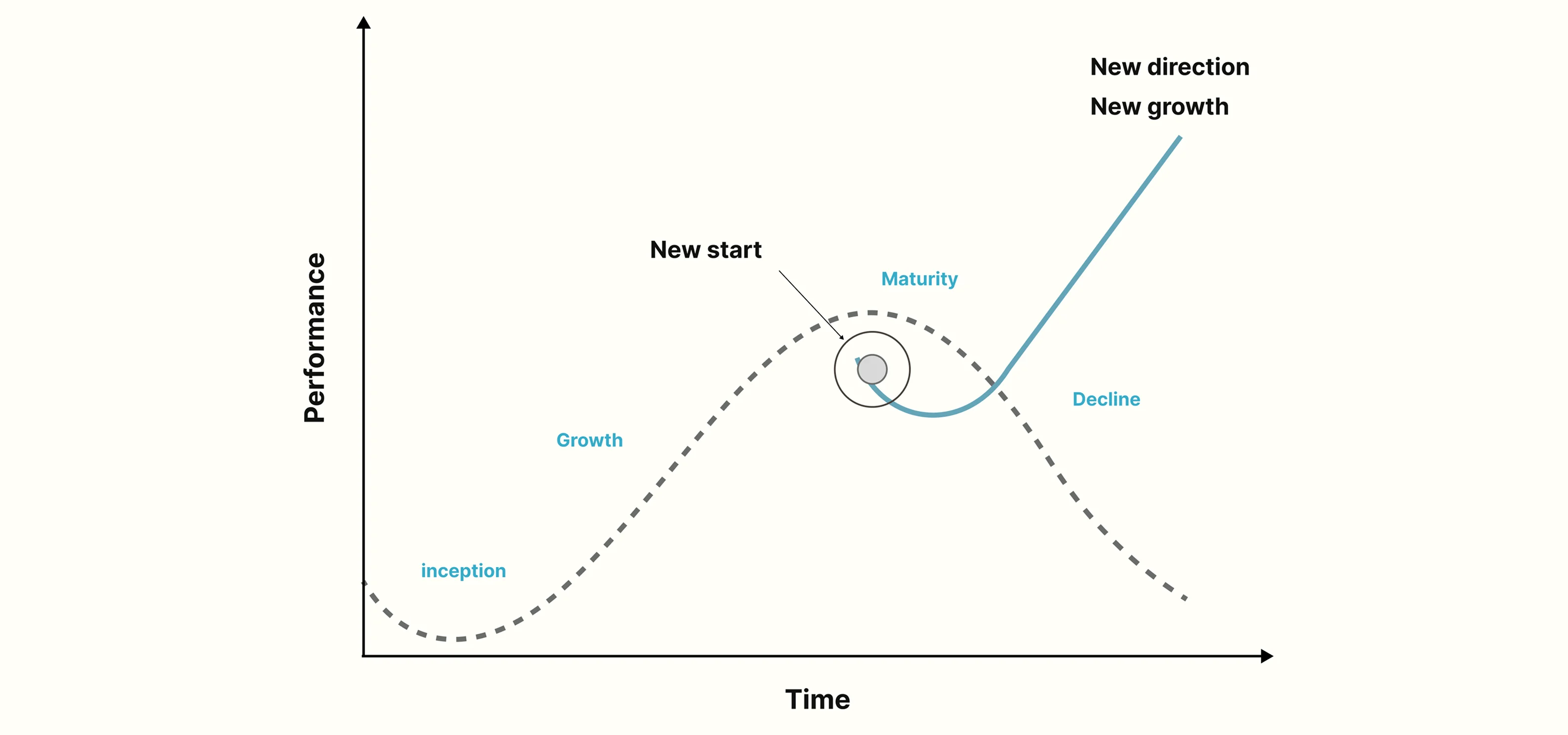
Both let you avoid crossing what I call the Low Status Moat - the valley where your competence drops and your status disappears as you move from one domain to another.
The moat is where agency gets built, and crossing the moat requires three things most people won't do:
Reclaiming Autonomy:
Your svadharma has no external scorecard. You must choose your direction knowing you might choose wrong.
You must sit with uncertainty long enough to figure out what YOU actually want - not what you think you should want.
The discomfort: Taking responsibility for outcomes.
The requirement: Choose anyway. Accept that clarity comes from commitment, not before it.
Reclaiming Competence:
Your svadharma requires building capability in areas where you start incompetent. You must do repetitive, unglamorous work. Get real feedback. Improve systematically. Build over years, not weeks. Accept that AI might make your skill obsolete and build it anyway because the building itself changes you.
The discomfort: Low status. Looking like a beginner when you used to be an expert.
The requirement: Build anyway. Master something because it's yours to master, not because it's guaranteed to pay off. Trust that your talent stack compounds even when specific skills don't.
Reclaiming Relatedness:
Your svadharma requires showing up as yourself. Not the curated version. You must risk vulnerability. Have real conversations. Accept that some people will reject the real you.
The discomfort: Vulnerability. Real conversations. Genuine presence. The possibility of rejection.
The requirement: Show up anyway. Risk rejection to build genuine belonging. Accept that one real connection matters more than a thousand curated impressions.
Swadharma is the only thing that actually fills the hollowness. It is the realisation that you are not here to be entertained (Degeneracy) or to be at peace (God).
You are here ‘because what you can be, you must be’.
Why I'm in Bombay Writing
People ask why I'm in a cramped Bombay apartment writing essays instead of partying in Ibiza or doing beach yoga in Goa.
The exit felt empty the moment it arrived because my self-worth was completely fused with the company's valuation. I'd been chasing external validation - VCs' scorecards, unicorn metrics, someone else's definition of success.
Finishing my yoga practice with a G-shot Americano, watching people (including myself) perform enlightenment for Instagram, I realised I was doing the same thing with different vocabulary. Still seeking external validation. Still running from the question: What is MY dharma?
Writing is my attempt at the terrifying middle path. About the discomfort of not knowing. The discomfort of building without external validation. The discomfort of showing up as myself, not my curated version.
I avoid the casino impulse, like calling for checking analytics, or refreshing LinkedIn to check validation, and I also avoid the monastery impulse of telling myself, "I'm above needing validation."
The test is to sit with both impulses without acting on them.
This isn't because writing is my "calling" or my "passion." I don't know if it is. But it's the clearest expression of my svadharma I can identify right now: Making sense of what I'm seeing. Sharing it publicly. Building capacity to sit with uncertainty. Doing this work, whether or not it produces the fruits I want.
Not because I've arrived. But because… this is what I can be, so this is what I must be.
Conclusion: "I am Long Both, But I Choose Neither"
The "Escapism Economy" is the safest bet of the decade because biology favours comfort. As an investor, I am both Long Degeneracy and Long God, betting on the split between the two, because the casinos will get fuller and the ashrams will get more expensive. But as a human being, I am shorting them both because I choose the messiness of my Swadharma.
The world will pay any price to avoid this messiness, but you can start today by simply doing the one piece of work you are afraid to show.
Because… what you can be, you must be.

To be continued…
A small favor...
I don't run ads. If this brought clarity, the biggest favor you can do is subscribe below.

.svg)

.svg)