


The cartoonist monk who saved my life
The cartoonist monk who saved my life
Scott Adams Accidentally Rewrote the Bhagavad Gita for Founders
INTRODUCTION
The book that changed everything for me arrived in the most unlikely moment, in the most unlikely place. I was lying in a hospital bed recovering from a stroke when a friend dropped a copy of How to Fail at Almost Everything and Still Win Big on my lap. The author was Scott Adams, the creator of Dilbert. I was annoyed, and sarcastically asked my friend - A cartoonist? Really? I'd just built India's leading alternative credit scoring company, and someone thought I needed business advice from the person who draws comics about incompetent managers?
Unable to work, my desperation led me to the book anyway, and what I found inside was the most practical spiritual manual I'd ever read, disguised as the musings of a rationalist cartoonist. It didn't just change how I built my companies thereafter. It changed how I built myself.
Scott Adams became the monk I didn't know I needed.
As a tribute to the mindset that helped me survive the journey from sleeping on the streets to selling my company to CRED, I'd like to share the three mental models I borrowed from Scott Adams.
Adams, the ‘monk’ who spoke in probabilities
Scott Adams was a trained hypnotist, a rationalist who spoke in probabilities, and someone who failed his way to a nine-figure net worth. He had no interest in Eastern philosophy. He wrote about biology, systems, and the mechanics of human attention. But when I read How to Fail at Almost Everything and Still Win Big, I realised he'd accidentally translated the Bhagavad Gita into founder-speak.
The Gita is 700 verses of Krishna explaining to Arjuna how to act without attachment, how to perform your duty without being destroyed by the outcomes. Most founders dismiss it as passive resignation. Adams showed me it's actually the most aggressive performance optimisation manual available.
Adams never taught spirituality - he reverse-engineered psychological conditions that help high performers sustain intensity without collapse. And those conditions happen to be identical to what yogic philosophy identified 2,500 years ago.
The Adams Principle#1: "Goals are for losers. Systems are for winners."
His Logic: When you set a goal - hit $10M ARR, raise Series B, get acquired - you exist in a state of continuous failure until the moment you achieve it. And if you do achieve it, you immediately need a new goal to avoid purposelessness.
A system is something you do every day that increases your odds of success regardless of immediate outcomes. The difference:
- The Goal: "Lose 10 pounds." (Requires willpower, creates a failure state until achieved)
- The System: A system is a daily process that increases your long-term odds of success regardless of immediate outcomes. "Eat right and exercise every day." (Requires discipline, creates a daily win, inevitably leads to weight loss)
The Monk's Translation:
This is Karma Yoga - the yoga of action. The Bhagavad Gita states: "You have a right to perform your prescribed duties, but you are not entitled to the fruits of your actions." When a founder focuses on the system (the input), they detach from the paralysing fear of results. They "win" every day, maintaining the energy necessary to stay in the game long enough for compounding to work.
The Science:
Angela Duckworth's research on grit shows that process-oriented achievers outperform outcome-oriented ones by significant margins. The outcome-focused students experienced anxiety during preparation and relief during success. The process-focused students experienced engagement during preparation and satisfaction during success. Same results, opposite emotional trajectories.
Neuroscience confirms this: When you focus on controllable inputs rather than uncertain outcomes, your prefrontal cortex operates more efficiently, and you make better decisions because you're not cognitively burdened by attachment to specific results.
Personal Application:
At CreditVidya and in my personal life, I've created systems that serve me well. One system: write and publish my weekly column every Monday at 11:11 AM. Another: one meal a day. I don't worry about whether each piece goes viral or whether I've lost exactly X pounds. I execute the system.
The Founder's Lesson:
Shift from goals to systems. Build daily practices that compound over time, regardless of immediate outcomes.
Scott Adams Accidentally Rewrote the Bhagavad Gita for Founders
INTRODUCTION
The book that changed everything for me arrived in the most unlikely moment, in the most unlikely place. I was lying in a hospital bed recovering from a stroke when a friend dropped a copy of How to Fail at Almost Everything and Still Win Big on my lap. The author was Scott Adams, the creator of Dilbert. I was annoyed, and sarcastically asked my friend - A cartoonist? Really? I'd just built India's leading alternative credit scoring company, and someone thought I needed business advice from the person who draws comics about incompetent managers?
Unable to work, my desperation led me to the book anyway, and what I found inside was the most practical spiritual manual I'd ever read, disguised as the musings of a rationalist cartoonist. It didn't just change how I built my companies thereafter. It changed how I built myself.
Scott Adams became the monk I didn't know I needed.
As a tribute to the mindset that helped me survive the journey from sleeping on the streets to selling my company to CRED, I'd like to share the three mental models I borrowed from Scott Adams.
Adams, the ‘monk’ who spoke in probabilities
Scott Adams was a trained hypnotist, a rationalist who spoke in probabilities, and someone who failed his way to a nine-figure net worth. He had no interest in Eastern philosophy. He wrote about biology, systems, and the mechanics of human attention. But when I read How to Fail at Almost Everything and Still Win Big, I realised he'd accidentally translated the Bhagavad Gita into founder-speak.
The Gita is 700 verses of Krishna explaining to Arjuna how to act without attachment, how to perform your duty without being destroyed by the outcomes. Most founders dismiss it as passive resignation. Adams showed me it's actually the most aggressive performance optimisation manual available.
Adams never taught spirituality - he reverse-engineered psychological conditions that help high performers sustain intensity without collapse. And those conditions happen to be identical to what yogic philosophy identified 2,500 years ago.
The Adams Principle#1: "Goals are for losers. Systems are for winners."
His Logic: When you set a goal - hit $10M ARR, raise Series B, get acquired - you exist in a state of continuous failure until the moment you achieve it. And if you do achieve it, you immediately need a new goal to avoid purposelessness.
A system is something you do every day that increases your odds of success regardless of immediate outcomes. The difference:
- The Goal: "Lose 10 pounds." (Requires willpower, creates a failure state until achieved)
- The System: A system is a daily process that increases your long-term odds of success regardless of immediate outcomes. "Eat right and exercise every day." (Requires discipline, creates a daily win, inevitably leads to weight loss)
The Monk's Translation:
This is Karma Yoga - the yoga of action. The Bhagavad Gita states: "You have a right to perform your prescribed duties, but you are not entitled to the fruits of your actions." When a founder focuses on the system (the input), they detach from the paralysing fear of results. They "win" every day, maintaining the energy necessary to stay in the game long enough for compounding to work.
The Science:
Angela Duckworth's research on grit shows that process-oriented achievers outperform outcome-oriented ones by significant margins. The outcome-focused students experienced anxiety during preparation and relief during success. The process-focused students experienced engagement during preparation and satisfaction during success. Same results, opposite emotional trajectories.
Neuroscience confirms this: When you focus on controllable inputs rather than uncertain outcomes, your prefrontal cortex operates more efficiently, and you make better decisions because you're not cognitively burdened by attachment to specific results.
Personal Application:
At CreditVidya and in my personal life, I've created systems that serve me well. One system: write and publish my weekly column every Monday at 11:11 AM. Another: one meal a day. I don't worry about whether each piece goes viral or whether I've lost exactly X pounds. I execute the system.
The Founder's Lesson:
Shift from goals to systems. Build daily practices that compound over time, regardless of immediate outcomes.
The cartoonist monk who saved my life
Scott Adams Accidentally Rewrote the Bhagavad Gita for Founders
INTRODUCTION
The book that changed everything for me arrived in the most unlikely moment, in the most unlikely place. I was lying in a hospital bed recovering from a stroke when a friend dropped a copy of How to Fail at Almost Everything and Still Win Big on my lap. The author was Scott Adams, the creator of Dilbert. I was annoyed, and sarcastically asked my friend - A cartoonist? Really? I'd just built India's leading alternative credit scoring company, and someone thought I needed business advice from the person who draws comics about incompetent managers?
Unable to work, my desperation led me to the book anyway, and what I found inside was the most practical spiritual manual I'd ever read, disguised as the musings of a rationalist cartoonist. It didn't just change how I built my companies thereafter. It changed how I built myself.
Scott Adams became the monk I didn't know I needed.
As a tribute to the mindset that helped me survive the journey from sleeping on the streets to selling my company to CRED, I'd like to share the three mental models I borrowed from Scott Adams.
Adams, the ‘monk’ who spoke in probabilities
Scott Adams was a trained hypnotist, a rationalist who spoke in probabilities, and someone who failed his way to a nine-figure net worth. He had no interest in Eastern philosophy. He wrote about biology, systems, and the mechanics of human attention. But when I read How to Fail at Almost Everything and Still Win Big, I realised he'd accidentally translated the Bhagavad Gita into founder-speak.
The Gita is 700 verses of Krishna explaining to Arjuna how to act without attachment, how to perform your duty without being destroyed by the outcomes. Most founders dismiss it as passive resignation. Adams showed me it's actually the most aggressive performance optimisation manual available.
Adams never taught spirituality - he reverse-engineered psychological conditions that help high performers sustain intensity without collapse. And those conditions happen to be identical to what yogic philosophy identified 2,500 years ago.
The Adams Principle#1: "Goals are for losers. Systems are for winners."
His Logic: When you set a goal - hit $10M ARR, raise Series B, get acquired - you exist in a state of continuous failure until the moment you achieve it. And if you do achieve it, you immediately need a new goal to avoid purposelessness.
A system is something you do every day that increases your odds of success regardless of immediate outcomes. The difference:
- The Goal: "Lose 10 pounds." (Requires willpower, creates a failure state until achieved)
- The System: A system is a daily process that increases your long-term odds of success regardless of immediate outcomes. "Eat right and exercise every day." (Requires discipline, creates a daily win, inevitably leads to weight loss)
The Monk's Translation:
This is Karma Yoga - the yoga of action. The Bhagavad Gita states: "You have a right to perform your prescribed duties, but you are not entitled to the fruits of your actions." When a founder focuses on the system (the input), they detach from the paralysing fear of results. They "win" every day, maintaining the energy necessary to stay in the game long enough for compounding to work.
The Science:
Angela Duckworth's research on grit shows that process-oriented achievers outperform outcome-oriented ones by significant margins. The outcome-focused students experienced anxiety during preparation and relief during success. The process-focused students experienced engagement during preparation and satisfaction during success. Same results, opposite emotional trajectories.
Neuroscience confirms this: When you focus on controllable inputs rather than uncertain outcomes, your prefrontal cortex operates more efficiently, and you make better decisions because you're not cognitively burdened by attachment to specific results.
Personal Application:
At CreditVidya and in my personal life, I've created systems that serve me well. One system: write and publish my weekly column every Monday at 11:11 AM. Another: one meal a day. I don't worry about whether each piece goes viral or whether I've lost exactly X pounds. I execute the system.
The Founder's Lesson:
Shift from goals to systems. Build daily practices that compound over time, regardless of immediate outcomes.
The Adams Principle # 2: "The Talent Stack."
His Logic: Adams admits he's not the funniest person on earth. He's not the best artist (he calls his art "mediocre"). He's not the savviest businessman. But he's in the top 25% of all three. That intersection created Dilbert, a global empire that no single specialist could replicate.
The conventional wisdom says: Be world-class at one thing. Adams argues this is mathematically impossible for 99% of us and strategically stupid even if achievable. Instead, become good enough - top 25% - at two or three different things. That combination creates a monopoly.
The Monk's Translation:
This is Swadharma - your own unique nature, your dharma. The Bhagavad Gita emphasises that it's better to perform your own duty imperfectly than to perform another's duty perfectly. When you try to be someone else's version of success, you're in a state of constant internal conflict. The yogis call this Avidya - ignorance of your true nature. Your authentic stack requires less energy to maintain because it's aligned with who you actually are.
The Science:
Michael Porter's work on competitive advantage shows that sustainable advantage comes from unique combinations, not from being the best at any single activity. In the age of AI, this becomes even more critical. AI can match specialists in isolated skills. But it cannot replicate the unique intersection of your specific experiences, perspectives, and capabilities. Research on network effects in skill development shows that each additional skill doesn't just add value - it multiplies the utility of existing skills.
Neuroscience confirms this: When you focus on controllable inputs rather than uncertain outcomes, your prefrontal cortex operates more efficiently, and you make better decisions because you're not cognitively burdened by attachment to specific results.
Personal Application:
I know I'm not as wise as Kunal Shah. I'm not as fit as Jitendra Chouksey. I'm not as effective a writer as Dan Koe. If I compete with any of them in their domain, I'll lose.
But I'm not competing in their domains. I'm building a stack nobody else has:
- Yoga teacher who understands the mechanics of sustainable performance.
- Founder with a successful exit who's lived the journey.
- Writer who tells honest, uncomfortable truths to young founders.
- Someone who maintains under 10% body fat while building companies.
Individually? Each piece is in the top 25% at best. Combined? Show me another founder who can play these four roles together?
That's not arrogance. That's mathematics. The probability of finding one person in the top 25% of a skill is 25%. The probability of finding someone in the top 25% of four different skills is 0.39%. That's roughly 1 in 256 people.
I watch founders destroy themselves trying to become technical when they're naturally commercial, or trying to become hustlers when they're naturally systems thinkers. Your job is to identify the unique combination that only you have, then build something that requires exactly that stack.
The Founder's Lesson:
Stop trying to be world-class at one thing. Start building a combination nobody can copy.
Map your unique stack:
- What are you top 25% at? (List everything, even if it seems unrelated to business)
- Which combinations are rare? (Most people can code OR sell, few can do both)
- What can you build that requires YOUR specific combination? (Not what VCs fund, what only you can execute)
In the age of AI and infinite competition, your monopoly is the intersection of skills and experiences that can't be replicated. Your monopoly is you!
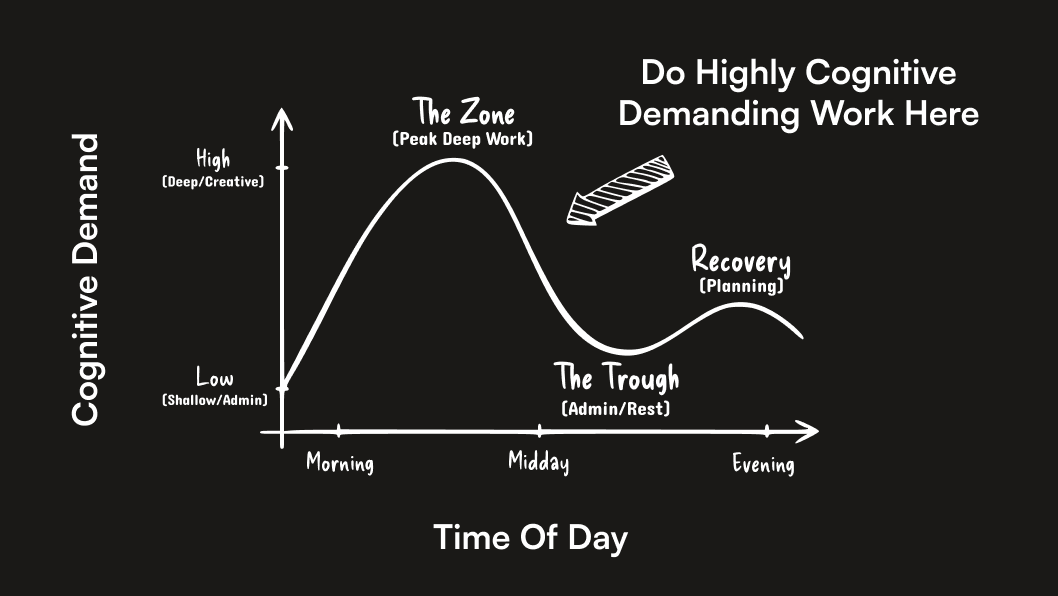
The Adams Principle#3: "Manage your energy, not your time."
His Logic: Adams has a filter for every decision: "Will this increase my personal energy? Does this give me more fuel or drain my tank?”
He prioritises diet, sleep, and fitness above "productivity." He treats his body not as a vehicle to be pushed until it breaks, but as a generator that powers everything else. As Adams notes: "When I get my personal energy right, the quality of my work is better, and I can complete it faster."
The Monk's Translation:
This is the cultivation of Prana - life force. The Yoga Sutras teach that every action, every thought, every interaction either builds Prana or depletes it. Your energy isn't a byproduct of your work - it's the substrate that makes work possible.
The principle of Sattva (clarity, balance, harmony) emerges only when energy is managed properly. When you're operating on low energy, you slip into Tamas (inertia, darkness) or Rajas (frantic activity without direction). Neither state produces good decisions.
The Science:
A Harvard study tracking 4,000 executives found that those who exercised regularly made better decisions, had 27% higher emotional intelligence scores, and achieved 19% better business outcomes than sedentary peers. Your brain consumes approximately 20% of your body's total energy despite representing only 2% of body mass. The prefrontal cortex - responsible for strategic thinking, impulse control, and complex decision-making - is particularly glucose-hungry. When you're sleep-deprived, poorly nourished, or physically depleted, that's the first system to go offline.
Matthew Walker's research at UC Berkeley shows that after seventeen hours of wakefulness, your cognitive performance equals a blood alcohol content of 0.05%. You're legally impaired to drive, but we think it's acceptable to make million-dollar decisions in that state.
Personal Application:
For seven years at CreditVidya, I treated my body like an inconvenience. Five hours of sleep felt abundant. Eighty-hour weeks felt normal. I wore exhaustion like a medal. Then came the slipped disc and stroke.
That's when I started tracking what Adams had been preaching: energy as the primary metric. And I rebuilt everything around energy management. Now I work fewer hours but produce better outcomes. Four focused hours at 100% capacity beat twelve fragmented hours at 60% capacity. Every time.
The Founder's Lesson:
Stop measuring hours. Start measuring voltage.
Energy is the currency that buys everything else - time, attention, decision quality, resilience, creativity. You can't manufacture more of it by grinding harder. You can only protect what you have and invest it strategically.
You can read more on my Energy vs Calendar here.
The choice you're actually making
Scott Adams offers a paradox. He is a cynic who teaches optimism. A materialist who teaches spiritual detachment. A failure who teaches success.
For the founder, the "Monk" within his methods provides a rigorous framework for building something that lasts.
- Kill your goals. Build systems.
- Don't be a genius. Build a stack.
- Don't manage time. Manage energy.
Most founders think the choice is between being successful by suffering and losing by being content. But the real choice is between operating systems:
One system says: Attach your worth to outcomes and chase goals that make you anxious.
The other says: Detach from outcomes and build systems that help you win daily.
Scott Adams taught me that you can win big without suffering. You can build a system where you win every day. You can stack your weird skills until you are untouchable. And you can programme your brain to see doors where others see walls.
I didn't build a unicorn. But I built a life I don't need to escape from. And that, I think, is the only winning that matters.

To be continued…
A small favor...
I don't run ads. If this brought clarity, the biggest favor you can do is subscribe to the Monday letters.
Subscribe to Monday Letters →