A ‘must’ update for the algorithm of love
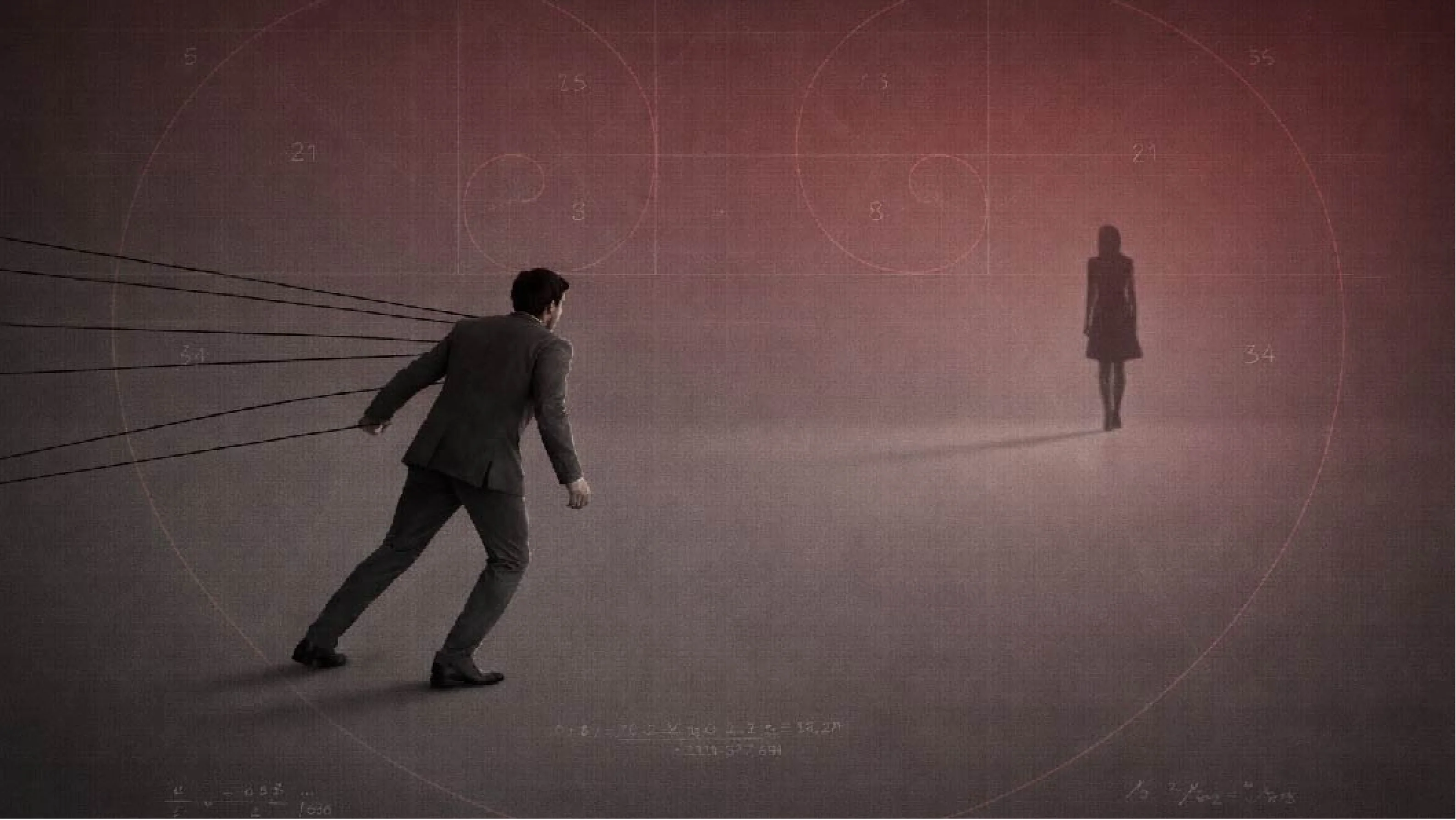
"You are playing ‘not to lose’ in a game you must play ‘to win’
Denial is sometimes the quiet language of love, but not exactly. We protect what we feel by pretending we do not feel it. Here’s a test.
What haunts you more?
- The woman who said no when you asked for her number three years ago?
- Or the woman you never approached, who is now married to someone else and posting vacation photos with the family you might have had?
You know the answer, but won’t admit it, because there’s a mismatch between evolutionary logic and modern reality. To admit the truth needs reconciling the two. Here’s my admission.
Her name was Asha. We were in the same MBA programme. She laughed at my corny jokes during group projects, and we grabbed coffee between lectures. I felt drawn to her, but I never asked her out. I kept telling myself I was waiting for the right moment, for certainty, for a sign that would guarantee a "yes." The moment never came. She married someone else two years after graduation. He wasn’t richer. He wasn’t smarter. He wasn’t better looking. He simply crossed the room while I was still calculating the odds. It still stings, not because she rejected me, but because I rejected myself. I tried to avoid a brief 'no' and ended up with a lifetime of 'what if.'
We often see romance as an emotional fog, but it is really a problem shaped by math and biology. If you feel frustrated being single, it is not because the dating pool is too small. It is because your brain evolved to help you survive in a world where mistakes could be deadly, and it often mistakes asking for a date to be so.

When I froze in a room smelling of sandalwood
Last month, a friend who is worried about my single status invited me to a 'spiritual dinner.' It was one of those events for conscious singles, with a vegetarian meal and a group Om before everyone started mingling. She said the date was really with yourself, but you also get to meet other like-minded single people. There were about thirty people on that terrace, all supposedly open to meeting someone. Still, no one made a move.
I stood there, realising I was repeating the same pattern that cost me Asha. I had spent seven years building a company, pitching to 100 venture capitalists, and taking 99 rejections to get the one 'yes' that led to a successful exit. In business, I saw rejection as just data. But in that room, with the scent of sandalwood in the air, I froze. I was afraid of having a bad interaction.
At that moment, I understood I had been using the wrong approach for years. I was choosing safety in a situation where taking risks is what actually works.
Romance is a Winner-Take-All market
The fundamental failure of modern romance stems from looking at it as a compatibility game. To understand why you remain single, you have to look at the difference between a value investor in Omaha and a venture capitalist in Palo Alto.
1. The Buffett Strategy: Playing Defensively - In public markets, Warren Buffett’s philosophy is famous: “Rule No. 1: Never lose money. Rule No. 2: Never forget Rule No. 1”.
- The Math: This strategy prioritises capital preservation because in the stock market, the downside is unbounded (you can go to zero), and the upside is generally bounded (you rarely make 1,000x returns overnight).
- The Mindset: A single bad investment can destroy you. Therefore, you must be skeptical. You look for reasons to say “no.” You optimise for safety.
2. The VC Strategy: Hunting the Unicorn - Venture Capital operates on an entirely different mathematical curve. It relies on the Power Law.
- The Math: Data shows that 0.4% of venture deals generate 50x returns or higher, effectively paying for every other failure in the fund. Peter Thiel wrote a 500,000 check to Facebook when it had zero revenue. *That single bet returned $*1.1 billion.
- The Mindset: This strategy is about taking risks. The downside is strictly capped (you lose your principal), but the upside is unbounded. A VC fund expects 90% of its startups to fail. They don’t care. They can afford to look foolish 99 times as long as they don’t miss the one Facebook.
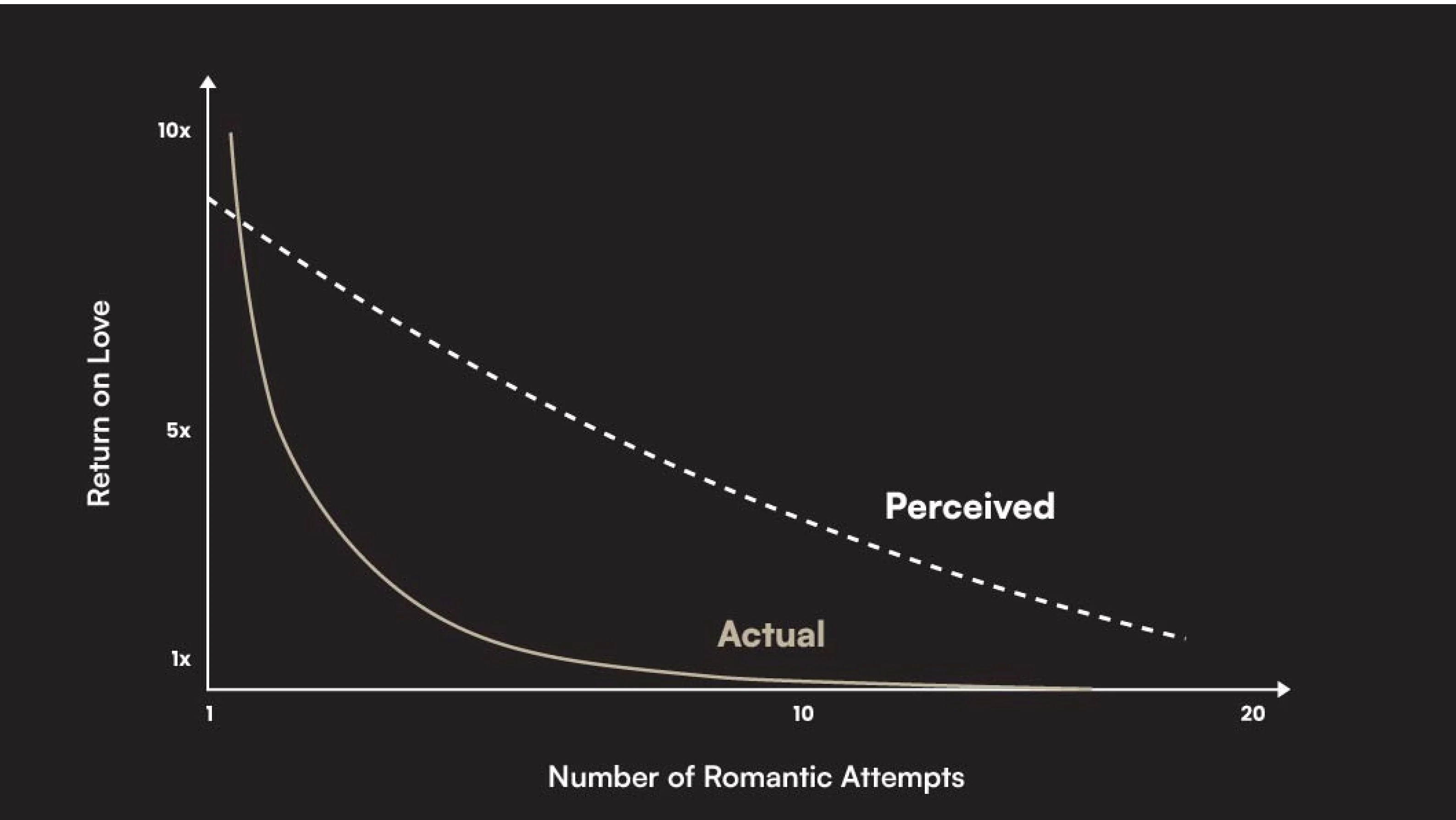
You will date N people in your life. For N minus one of those, the long-term value drops to zero because of breakups, ghosting, or incompatibility. But one successful match can bring decades of happiness, shared wealth, family, and even a longer life, all compared to the effort it took to find them.
- The Cost of a Bad Date: Capped at $50, three hours of time, and mild awkwardness.
- The Cost of Missing “The One”: The loss of a lifetime partnership. The cost is unbounded.
The tragedy is that most people date like Warren Buffett. We carefully screen potential partners to avoid a bad date, an awkward dinner, a cringe-worthy text, or rejection. We act as if a bad dinner is worse than ending up alone.
Why Rejection Feels Like Death
During the Ice Age, a false negative - not spotting the predator when it was there - meant death. A false positive - thinking the rustling grass was a lion when it was just wind - meant wasted energy running away.
Our ancestors who minimised false negatives survived. The ones who didn’t became lunch. Nature optimised the human brain for capital preservation. The “capital” is your life. It doesn’t matter if you were wrong 99 times about the lion; it only matters that you don’t miss it when it is actually there. Your brain is still protecting you from lions. BUT there are no lions. It floods your system with cortisol. It tells you that rejection is a survival threat. It forces you to play it safe.
Why can’t we just “think” our way out of this? Because the fear isn’t logical; it’s physical. When you contemplate asking someone out and fear the “No,” your brain is not metaphorically hurting; it is simulating physical injury.
- Ancestral Logic: In a tribe of 150 people, social rejection meant exile. Exile meant death by starvation or predator. Therefore, rejection was a survival threat.
- Modern Reality: Rejection by a stranger on Hinge has zero impact on your survival.
Your brain acts like an overprotective security guard, treating small social discomforts as if they are life-threatening. It constantly warns you about dangers that are not real, because it would rather let you be lonely than risk being hurt.
The Cult of Zero Error
We have constructed a cultural architecture that treats a bad date, an awkward approach, or a failed “situationship” not as the necessary cost of doing business, but as a shameful failure of judgment. We celebrate the “pre-jection - rejecting someone before they can reject you - as a form of empowerment.
Here is how five pillars of modern society are conspiring to bankrupt your romantic future by optimising for the wrong variable.
1. The Weaponisation of “Cringe”: In the ancestral environment, a failed courtship was a private embarrassment. Today, it is public content. Social media has introduced a “Cringe Tax” to dating.
- The Mechanism: We fear that an awkward approach or a vulnerable text will be screenshotted and broadcast to a group chat for ridicule. Dating has become a public performance of status.
- The result is that, to avoid looking foolish, we pretend not to care. We end up stuck, because making a visible mistake feels like a huge social risk.
2. The Efficiency Trap: Apps promise connection, but they are designed for “Exploitation” (immediate judgment) rather than “Exploration” (discovery).
- The Mechanism: The interface trains us to evaluate a human being in 3.19 seconds. We filter for “sparks” instantly, unaware that 67% of successful relationships begin as friendships with zero initial romantic intent.
- The result is that we swipe left on 96% of profiles. By insisting on instant certainty in just a few seconds, we end up missing the slow-burn partners, who actually make up most of the people we could connect with.
3. Modern empowerment narratives like “Know Your Worth” and “Don’t Settle” are powerful tools for salary negotiations and boundary setting. But when applied to the discovery phase of dating, they are mathematically disastrous.
- The Mechanism: We interpret “standards” as a refusal to tolerate friction. If a date is nervous, we label it a red flag. If the banter isn’t witty, we claim “no chemistry.” We treat “High Standards” as a virtue, when in a search problem, inflexible standards applied too early are just a fancy word for risk aversion.
- The result is that we expect someone to have all the qualities of a perfect partner on the first date. We act like late-stage private equity investors doing due diligence, instead of early-stage investors looking for potential.
4. The New Etiquette: Evolving social norms have rightfully penalised aggressive or unwanted behaviour. However, the pendulum has swung so far that we now conflate “uncertainty” with “intrusion.”
- The Mechanism: Men are increasingly conditioned to believe that approaching a woman is “creepy” unless they are 100% certain of a positive reception.
- The result is that men stop taking action when they are only 70% sure. Since it is impossible to be completely certain in human interactions, the men who care most about social norms end up doing nothing. They choose inaction to avoid making a mistake.
5. Self-Help Culture: The self-improvement industry teaches us to optimise every aspect of our lives. We believe that if we just check enough boxes, we can eliminate the risk of pain.
- The Mechanism: We believe we can “think” our way to the right partner. We scrutinise profiles for “red flags” (often just human quirks) to protect our peace.
- The Result is that we create a checklist nobody can meet. We optimise for a partner who looks good on paper (Status) rather than one who feels good in a relationship (Connection).
Each of these behaviours is rational in isolation. No one wants to be embarrassed. No one wants to waste time. No one wants to be creepy. But in aggregate, they create a market failure.
We have built a society that views the False Positive (the bad date, the rejection, the awkward moment) as a catastrophe to be avoided at all costs. We spend so much time protecting ourselves from small hurts that we miss out on something beautiful.
"You are playing ‘not to lose’ in a game you must play ‘to win’
Denial is sometimes the quiet language of love, but not exactly. We protect what we feel by pretending we do not feel it. Here’s a test.
What haunts you more?
- The woman who said no when you asked for her number three years ago?
- Or the woman you never approached, who is now married to someone else and posting vacation photos with the family you might have had?
You know the answer, but won’t admit it, because there’s a mismatch between evolutionary logic and modern reality. To admit the truth needs reconciling the two. Here’s my admission.
Her name was Asha. We were in the same MBA programme. She laughed at my corny jokes during group projects, and we grabbed coffee between lectures. I felt drawn to her, but I never asked her out. I kept telling myself I was waiting for the right moment, for certainty, for a sign that would guarantee a "yes." The moment never came. She married someone else two years after graduation. He wasn’t richer. He wasn’t smarter. He wasn’t better looking. He simply crossed the room while I was still calculating the odds. It still stings, not because she rejected me, but because I rejected myself. I tried to avoid a brief 'no' and ended up with a lifetime of 'what if.'
We often see romance as an emotional fog, but it is really a problem shaped by math and biology. If you feel frustrated being single, it is not because the dating pool is too small. It is because your brain evolved to help you survive in a world where mistakes could be deadly, and it often mistakes asking for a date to be so.
When I froze in a room smelling of sandalwood
Last month, a friend who is worried about my single status invited me to a 'spiritual dinner.' It was one of those events for conscious singles, with a vegetarian meal and a group Om before everyone started mingling. She said the date was really with yourself, but you also get to meet other like-minded single people. There were about thirty people on that terrace, all supposedly open to meeting someone. Still, no one made a move.
I stood there, realising I was repeating the same pattern that cost me Asha. I had spent seven years building a company, pitching to 100 venture capitalists, and taking 99 rejections to get the one 'yes' that led to a successful exit. In business, I saw rejection as just data. But in that room, with the scent of sandalwood in the air, I froze. I was afraid of having a bad interaction.
At that moment, I understood I had been using the wrong approach for years. I was choosing safety in a situation where taking risks is what actually works.
Romance is a Winner-Take-All market
The fundamental failure of modern romance stems from looking at it as a compatibility game. To understand why you remain single, you have to look at the difference between a value investor in Omaha and a venture capitalist in Palo Alto.
1. The Buffett Strategy: Playing Defensively - In public markets, Warren Buffett’s philosophy is famous: “Rule No. 1: Never lose money. Rule No. 2: Never forget Rule No. 1”.
- The Math: This strategy prioritises capital preservation because in the stock market, the downside is unbounded (you can go to zero), and the upside is generally bounded (you rarely make 1,000x returns overnight).
- The Mindset: A single bad investment can destroy you. Therefore, you must be skeptical. You look for reasons to say “no.” You optimise for safety.
2. The VC Strategy: Hunting the Unicorn - Venture Capital operates on an entirely different mathematical curve. It relies on the Power Law.
- The Math: Data shows that 0.4% of venture deals generate 50x returns or higher, effectively paying for every other failure in the fund. Peter Thiel wrote a 500,000 check to Facebook when it had zero revenue. *That single bet returned $*1.1 billion.
- The Mindset: This strategy is about taking risks. The downside is strictly capped (you lose your principal), but the upside is unbounded. A VC fund expects 90% of its startups to fail. They don’t care. They can afford to look foolish 99 times as long as they don’t miss the one Facebook.
You will date N people in your life. For N minus one of those, the long-term value drops to zero because of breakups, ghosting, or incompatibility. But one successful match can bring decades of happiness, shared wealth, family, and even a longer life, all compared to the effort it took to find them.
- The Cost of a Bad Date: Capped at $50, three hours of time, and mild awkwardness.
- The Cost of Missing “The One”: The loss of a lifetime partnership. The cost is unbounded.
The tragedy is that most people date like Warren Buffett. We carefully screen potential partners to avoid a bad date, an awkward dinner, a cringe-worthy text, or rejection. We act as if a bad dinner is worse than ending up alone.
Why Rejection Feels Like Death
During the Ice Age, a false negative - not spotting the predator when it was there - meant death. A false positive - thinking the rustling grass was a lion when it was just wind - meant wasted energy running away.
Our ancestors who minimised false negatives survived. The ones who didn’t became lunch. Nature optimised the human brain for capital preservation. The “capital” is your life. It doesn’t matter if you were wrong 99 times about the lion; it only matters that you don’t miss it when it is actually there. Your brain is still protecting you from lions. BUT there are no lions. It floods your system with cortisol. It tells you that rejection is a survival threat. It forces you to play it safe.
Why can’t we just “think” our way out of this? Because the fear isn’t logical; it’s physical. When you contemplate asking someone out and fear the “No,” your brain is not metaphorically hurting; it is simulating physical injury.
- Ancestral Logic: In a tribe of 150 people, social rejection meant exile. Exile meant death by starvation or predator. Therefore, rejection was a survival threat.
- Modern Reality: Rejection by a stranger on Hinge has zero impact on your survival.
Your brain acts like an overprotective security guard, treating small social discomforts as if they are life-threatening. It constantly warns you about dangers that are not real, because it would rather let you be lonely than risk being hurt.
The Cult of Zero Error
We have constructed a cultural architecture that treats a bad date, an awkward approach, or a failed “situationship” not as the necessary cost of doing business, but as a shameful failure of judgment. We celebrate the “pre-jection - rejecting someone before they can reject you - as a form of empowerment.
Here is how five pillars of modern society are conspiring to bankrupt your romantic future by optimising for the wrong variable.
1. The Weaponisation of “Cringe”: In the ancestral environment, a failed courtship was a private embarrassment. Today, it is public content. Social media has introduced a “Cringe Tax” to dating.
- The Mechanism: We fear that an awkward approach or a vulnerable text will be screenshotted and broadcast to a group chat for ridicule. Dating has become a public performance of status.
- The result is that, to avoid looking foolish, we pretend not to care. We end up stuck, because making a visible mistake feels like a huge social risk.
2. The Efficiency Trap: Apps promise connection, but they are designed for “Exploitation” (immediate judgment) rather than “Exploration” (discovery).
- The Mechanism: The interface trains us to evaluate a human being in 3.19 seconds. We filter for “sparks” instantly, unaware that 67% of successful relationships begin as friendships with zero initial romantic intent.
- The result is that we swipe left on 96% of profiles. By insisting on instant certainty in just a few seconds, we end up missing the slow-burn partners, who actually make up most of the people we could connect with.
3. Modern empowerment narratives like “Know Your Worth” and “Don’t Settle” are powerful tools for salary negotiations and boundary setting. But when applied to the discovery phase of dating, they are mathematically disastrous.
- The Mechanism: We interpret “standards” as a refusal to tolerate friction. If a date is nervous, we label it a red flag. If the banter isn’t witty, we claim “no chemistry.” We treat “High Standards” as a virtue, when in a search problem, inflexible standards applied too early are just a fancy word for risk aversion.
- The result is that we expect someone to have all the qualities of a perfect partner on the first date. We act like late-stage private equity investors doing due diligence, instead of early-stage investors looking for potential.
4. The New Etiquette: Evolving social norms have rightfully penalised aggressive or unwanted behaviour. However, the pendulum has swung so far that we now conflate “uncertainty” with “intrusion.”
- The Mechanism: Men are increasingly conditioned to believe that approaching a woman is “creepy” unless they are 100% certain of a positive reception.
- The result is that men stop taking action when they are only 70% sure. Since it is impossible to be completely certain in human interactions, the men who care most about social norms end up doing nothing. They choose inaction to avoid making a mistake.
5. Self-Help Culture: The self-improvement industry teaches us to optimise every aspect of our lives. We believe that if we just check enough boxes, we can eliminate the risk of pain.
- The Mechanism: We believe we can “think” our way to the right partner. We scrutinise profiles for “red flags” (often just human quirks) to protect our peace.
- The Result is that we create a checklist nobody can meet. We optimise for a partner who looks good on paper (Status) rather than one who feels good in a relationship (Connection).
Each of these behaviours is rational in isolation. No one wants to be embarrassed. No one wants to waste time. No one wants to be creepy. But in aggregate, they create a market failure.
We have built a society that views the False Positive (the bad date, the rejection, the awkward moment) as a catastrophe to be avoided at all costs. We spend so much time protecting ourselves from small hurts that we miss out on something beautiful.
A ‘must’ update for the algorithm of love
"You are playing ‘not to lose’ in a game you must play ‘to win’
Denial is sometimes the quiet language of love, but not exactly. We protect what we feel by pretending we do not feel it. Here’s a test.
What haunts you more?
- The woman who said no when you asked for her number three years ago?
- Or the woman you never approached, who is now married to someone else and posting vacation photos with the family you might have had?
You know the answer, but won’t admit it, because there’s a mismatch between evolutionary logic and modern reality. To admit the truth needs reconciling the two. Here’s my admission.
Her name was Asha. We were in the same MBA programme. She laughed at my corny jokes during group projects, and we grabbed coffee between lectures. I felt drawn to her, but I never asked her out. I kept telling myself I was waiting for the right moment, for certainty, for a sign that would guarantee a "yes." The moment never came. She married someone else two years after graduation. He wasn’t richer. He wasn’t smarter. He wasn’t better looking. He simply crossed the room while I was still calculating the odds. It still stings, not because she rejected me, but because I rejected myself. I tried to avoid a brief 'no' and ended up with a lifetime of 'what if.'
We often see romance as an emotional fog, but it is really a problem shaped by math and biology. If you feel frustrated being single, it is not because the dating pool is too small. It is because your brain evolved to help you survive in a world where mistakes could be deadly, and it often mistakes asking for a date to be so.
When I froze in a room smelling of sandalwood
Last month, a friend who is worried about my single status invited me to a 'spiritual dinner.' It was one of those events for conscious singles, with a vegetarian meal and a group Om before everyone started mingling. She said the date was really with yourself, but you also get to meet other like-minded single people. There were about thirty people on that terrace, all supposedly open to meeting someone. Still, no one made a move.
I stood there, realising I was repeating the same pattern that cost me Asha. I had spent seven years building a company, pitching to 100 venture capitalists, and taking 99 rejections to get the one 'yes' that led to a successful exit. In business, I saw rejection as just data. But in that room, with the scent of sandalwood in the air, I froze. I was afraid of having a bad interaction.
At that moment, I understood I had been using the wrong approach for years. I was choosing safety in a situation where taking risks is what actually works.
Romance is a Winner-Take-All market
The fundamental failure of modern romance stems from looking at it as a compatibility game. To understand why you remain single, you have to look at the difference between a value investor in Omaha and a venture capitalist in Palo Alto.
1. The Buffett Strategy: Playing Defensively - In public markets, Warren Buffett’s philosophy is famous: “Rule No. 1: Never lose money. Rule No. 2: Never forget Rule No. 1”.
- The Math: This strategy prioritises capital preservation because in the stock market, the downside is unbounded (you can go to zero), and the upside is generally bounded (you rarely make 1,000x returns overnight).
- The Mindset: A single bad investment can destroy you. Therefore, you must be skeptical. You look for reasons to say “no.” You optimise for safety.
2. The VC Strategy: Hunting the Unicorn - Venture Capital operates on an entirely different mathematical curve. It relies on the Power Law.
- The Math: Data shows that 0.4% of venture deals generate 50x returns or higher, effectively paying for every other failure in the fund. Peter Thiel wrote a 500,000 check to Facebook when it had zero revenue. *That single bet returned $*1.1 billion.
- The Mindset: This strategy is about taking risks. The downside is strictly capped (you lose your principal), but the upside is unbounded. A VC fund expects 90% of its startups to fail. They don’t care. They can afford to look foolish 99 times as long as they don’t miss the one Facebook.
You will date N people in your life. For N minus one of those, the long-term value drops to zero because of breakups, ghosting, or incompatibility. But one successful match can bring decades of happiness, shared wealth, family, and even a longer life, all compared to the effort it took to find them.
- The Cost of a Bad Date: Capped at $50, three hours of time, and mild awkwardness.
- The Cost of Missing “The One”: The loss of a lifetime partnership. The cost is unbounded.
The tragedy is that most people date like Warren Buffett. We carefully screen potential partners to avoid a bad date, an awkward dinner, a cringe-worthy text, or rejection. We act as if a bad dinner is worse than ending up alone.
Why Rejection Feels Like Death
During the Ice Age, a false negative - not spotting the predator when it was there - meant death. A false positive - thinking the rustling grass was a lion when it was just wind - meant wasted energy running away.
Our ancestors who minimised false negatives survived. The ones who didn’t became lunch. Nature optimised the human brain for capital preservation. The “capital” is your life. It doesn’t matter if you were wrong 99 times about the lion; it only matters that you don’t miss it when it is actually there. Your brain is still protecting you from lions. BUT there are no lions. It floods your system with cortisol. It tells you that rejection is a survival threat. It forces you to play it safe.
Why can’t we just “think” our way out of this? Because the fear isn’t logical; it’s physical. When you contemplate asking someone out and fear the “No,” your brain is not metaphorically hurting; it is simulating physical injury.
- Ancestral Logic: In a tribe of 150 people, social rejection meant exile. Exile meant death by starvation or predator. Therefore, rejection was a survival threat.
- Modern Reality: Rejection by a stranger on Hinge has zero impact on your survival.
Your brain acts like an overprotective security guard, treating small social discomforts as if they are life-threatening. It constantly warns you about dangers that are not real, because it would rather let you be lonely than risk being hurt.
The Cult of Zero Error
We have constructed a cultural architecture that treats a bad date, an awkward approach, or a failed “situationship” not as the necessary cost of doing business, but as a shameful failure of judgment. We celebrate the “pre-jection - rejecting someone before they can reject you - as a form of empowerment.
Here is how five pillars of modern society are conspiring to bankrupt your romantic future by optimising for the wrong variable.
1. The Weaponisation of “Cringe”: In the ancestral environment, a failed courtship was a private embarrassment. Today, it is public content. Social media has introduced a “Cringe Tax” to dating.
- The Mechanism: We fear that an awkward approach or a vulnerable text will be screenshotted and broadcast to a group chat for ridicule. Dating has become a public performance of status.
- The result is that, to avoid looking foolish, we pretend not to care. We end up stuck, because making a visible mistake feels like a huge social risk.
2. The Efficiency Trap: Apps promise connection, but they are designed for “Exploitation” (immediate judgment) rather than “Exploration” (discovery).
- The Mechanism: The interface trains us to evaluate a human being in 3.19 seconds. We filter for “sparks” instantly, unaware that 67% of successful relationships begin as friendships with zero initial romantic intent.
- The result is that we swipe left on 96% of profiles. By insisting on instant certainty in just a few seconds, we end up missing the slow-burn partners, who actually make up most of the people we could connect with.
3. Modern empowerment narratives like “Know Your Worth” and “Don’t Settle” are powerful tools for salary negotiations and boundary setting. But when applied to the discovery phase of dating, they are mathematically disastrous.
- The Mechanism: We interpret “standards” as a refusal to tolerate friction. If a date is nervous, we label it a red flag. If the banter isn’t witty, we claim “no chemistry.” We treat “High Standards” as a virtue, when in a search problem, inflexible standards applied too early are just a fancy word for risk aversion.
- The result is that we expect someone to have all the qualities of a perfect partner on the first date. We act like late-stage private equity investors doing due diligence, instead of early-stage investors looking for potential.
4. The New Etiquette: Evolving social norms have rightfully penalised aggressive or unwanted behaviour. However, the pendulum has swung so far that we now conflate “uncertainty” with “intrusion.”
- The Mechanism: Men are increasingly conditioned to believe that approaching a woman is “creepy” unless they are 100% certain of a positive reception.
- The result is that men stop taking action when they are only 70% sure. Since it is impossible to be completely certain in human interactions, the men who care most about social norms end up doing nothing. They choose inaction to avoid making a mistake.
5. Self-Help Culture: The self-improvement industry teaches us to optimise every aspect of our lives. We believe that if we just check enough boxes, we can eliminate the risk of pain.
- The Mechanism: We believe we can “think” our way to the right partner. We scrutinise profiles for “red flags” (often just human quirks) to protect our peace.
- The Result is that we create a checklist nobody can meet. We optimise for a partner who looks good on paper (Status) rather than one who feels good in a relationship (Connection).
Each of these behaviours is rational in isolation. No one wants to be embarrassed. No one wants to waste time. No one wants to be creepy. But in aggregate, they create a market failure.
We have built a society that views the False Positive (the bad date, the rejection, the awkward moment) as a catastrophe to be avoided at all costs. We spend so much time protecting ourselves from small hurts that we miss out on something beautiful.

Resonating with this philosophy?
Join the smartest founders mastering the inner game to face the unknown. Read by YC & Sequoia.

Chemistry is a lagging Indicator
The Statistic That Changes Everything: A study of nearly 2,000 people found that 67% of successful relationships began as friendships. Crucially, the majority of these people reported no romantic attraction at the start.
Think about that.
Two-thirds of happy couples would have swiped left on each other. Chemistry comes later, after trust is built. Research shows it takes about six months to really know if someone is right for marriage, but dating apps expect you to decide in just a few seconds.
You’re eliminating 67% of your potential partners by demanding instant fireworks.
The person who seems boring on the first date could be your soulmate. The one who excites you might lose interest in a few months. By insisting on instant certainty, you are almost sure to miss the slow-burn partners, who make up most of your real options.
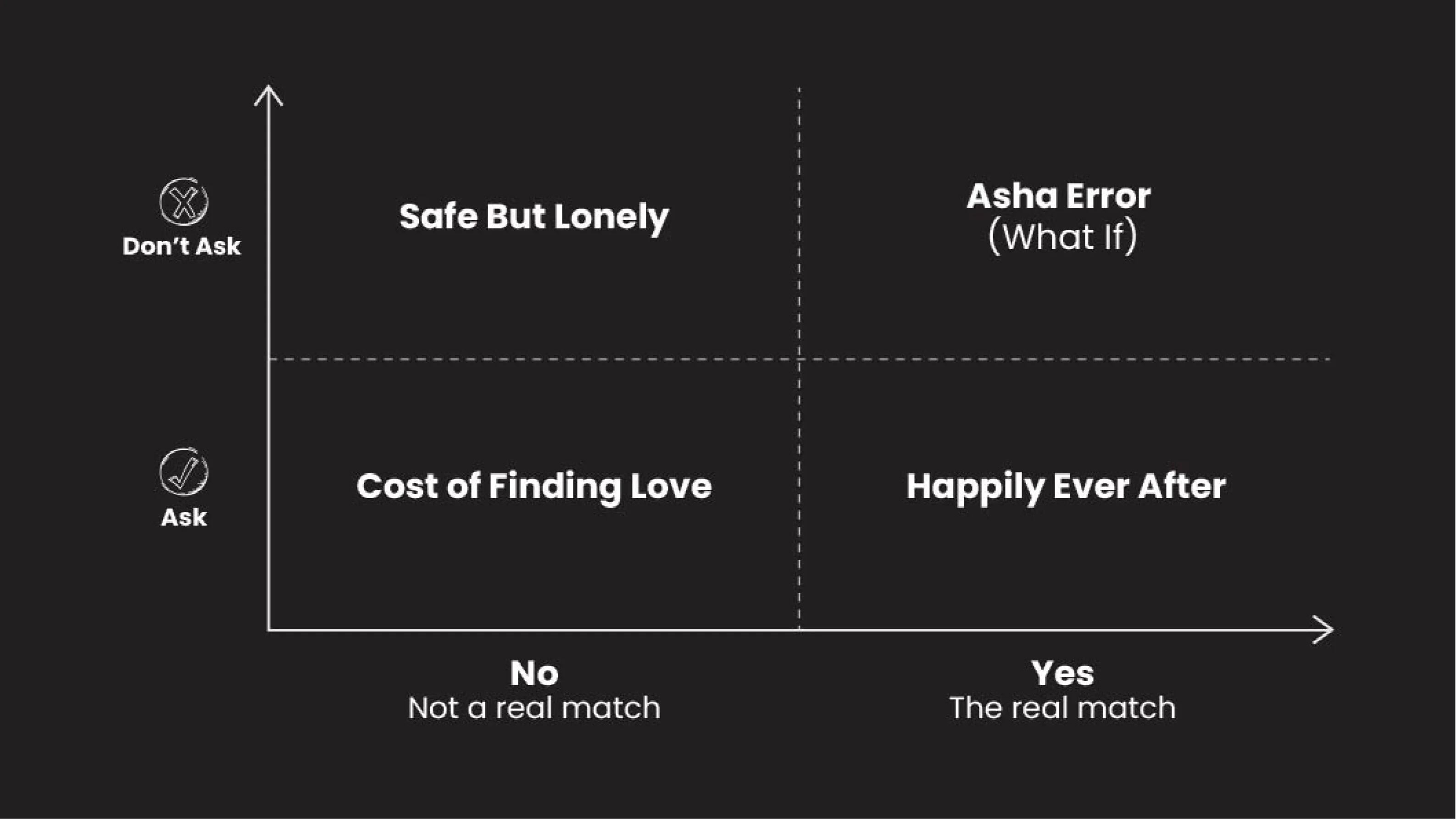
To find your unicorn, you must invert your loss function.
1. Seek Rejection (The VC Mindset) In a power-law game, “no” is not a failure; it is the cost of doing business.
- Mindset Shift: A bad date costs you $50. Missing your soulmate costs you your life. Aggressively tolerate bad dates. If you aren’t failing, you aren’t sampling enough of the market to find the outlier.
2. Move at 70% Jeff Bezos has a rule: If you wait for 100% of the information to make a decision, you are too late. You must act when you have 70% of the data. Don’t wait for “The Spark.” If they are kind, interesting, and safe (70%), go on the second date. Let conviction build over time.
3. Disable the Smoke Detector When you feel the “ick,” ask yourself: Is this person unsafe? Or is my insula just reacting to a new flavour? Unless it violates a core value, ignore the alarm.
Cross the Room
I have now been rejected more in the last three months than I was in three years building CreditVidya.
I have been rejected by a cute girl at Sequel (a quaint cafe in Bandra, Bombay). I have been rejected on dating apps. I have been rejected at mixers. But here is the data point that matters: I do not remember their names.
The sting of those rejections lasted minutes. But I still remember Asha. I still remember the gas station where she asked me to come to Vegas with her. I decided to play it safe. I wish I had said yes.
So, the next time you are at a coffee shop, a party, or a spiritual dinner that smells of sandalwood, and you see someone interesting, do not wait for the perfect moment.
Do not be the guy who waits two years for a sign that never comes.
They might say no. That is data, not identity. You will survive. But they might say yes. That is how three dates turn into three years, which turn into thirty years.
Ten years from now, you won’t remember the name of the person who rejected you. But you will remember the name of the person you never asked.
I hope the social media algorithm works in a way that this article gets to Asha. I hope she knows that if I could go back to that moment before Vegas, I wouldn’t calculate the odds. I would pack a bag.
Now, go, cross the room.
Say, “May I meet you?”

To be continued…
A small favor...
I don't run ads. If this brought clarity, the biggest favor you can do is subscribe below.

.svg)

.svg)