
The founders’
Olympics of suffering

Where Winning the Wrong Game Is Considered An Achievement
Last week, in the opening match of the T20 World Cup, defending champions India were staring at humiliation at the hands of minnows USA, with the scorecard reading 46 for 4 when Suryakumar Yadav walked out to bat. By the 13th over, the score was 77 for 6. But then the indomitable SKY produced yet another scintillating knock, scoring 84* in 49 balls. We won the match. He took the ‘player of the match’ honour, one more time. Why is SKY so consistent and dependable? The answer could be found in what he said later. After the innings, Surya said something most founders would never think of: "I felt alone after I played the last series of 2025 against South Africa. I packed my kit bag, and spent a lot of time with family for two weeks. Then started in the new year."
Basically, to power his team’s February mission, he planned a ‘deliberate pause’ in January. No nets. No analysis. Just rest.
Now ask yourself: When was the last time you took two weeks away from your company?
Not in immediate memory, I am sure. And there’s a reason behind it. In cricket, nobody questioned Surya's commitment because he rested. Nobody called him soft because in sports, performance is the only scoreboard. Runs. Strike rate. Trophies. The system rewards what you produce, not what it costs you.
But somewhere in the world of building companies, we swapped the scoreboard with something else. We stopped measuring founders by the Gold Medals (Revenue/Product) and started measuring them by self-inflicted Injuries (Sleep lost/Stress). Narayana Murthy tells young Indians to work seventy hours a week. The room nods. Nobody asks: Seventy hours of what? Producing what? For whom? The hours have become the point. The suffering has become the credential.
This is Performative Suffering - an effort whose primary function isn't to produce outcomes, but to signal commitment.
In sport, you play to win. In startups, we have learned to play to suffer.

Why We Do It: The Peacock’s Tail
Why do highly intelligent founders destroy their own cognitive capacity? Why do we play to suffer?
The answer lies in Costly Signalling Theory.
In 1975, evolutionary biologist Amotz Zahavi asked a deceptively simple question: Why does the peacock carry a tail that makes it harder to survive? It is heavy. It burns calories. It attracts tigers. It is objectively a bad survival strategy.
His answer became the Handicap Principle: A signal is believable precisely because it is costly. The tail proves to the peahen: "I am so genetically fit that I can survive even with this heavy, useless thing on my back."
Your burnout is a Peacock Tail.
In an environment of extreme uncertainty, investors and employees cannot see inside your head to measure your true commitment. They need a proxy.
- It serves no business purpose to work until 3:00 AM.
- It serves no business purpose to skip lunch.
- It serves no business purpose to ignore your family.
But it proves - to investors, to your team, and to yourself - that you are "The Real Deal." The suffering is the certificate. You aren't working hard to build the company; you are working hard to prove you are a Founder.
The Social Lock: Fear and Status
Once this signal is established, a Fear Architecture locks it in.
1. The "Impostor" Tax: 71% of CEOs report feeling like impostors. That's because the higher one rises, the less certain the ground feels beneath them. They are always fighting this feeling - what if they discover I’m just figuring this out like everyone else? When you feel like a fraud, you use suffering as a shield. The logic is unconscious: "I may not be the smartest person here, but if I am the most exhausted, no one can say I don't deserve my seat."
2. Social Comparison Theory explains why this escalates. When your LinkedIn feed is full of peers bragging about the "grind," the baseline for "normal" shifts. If everyone else is signalling 100-hour weeks, resting feels like a dangerous defect.
3. Status Competition Research confirms that in the modern knowledge economy, busyness has replaced leisure as the dominant status symbol. Being the "hardest worker in the room" confers bragging rights. It becomes a game of "Martyrdom Poker": Who slept less? Who sacrificed more?
The winner gains social capital, but they lose the very capacity of thinking clearly needed to actually win the game.
What does it cost you?
The problem with the Olympics of Suffering isn't just that it's performative. For the sceptical leader, the numbers paint a stark picture of lost capacity.
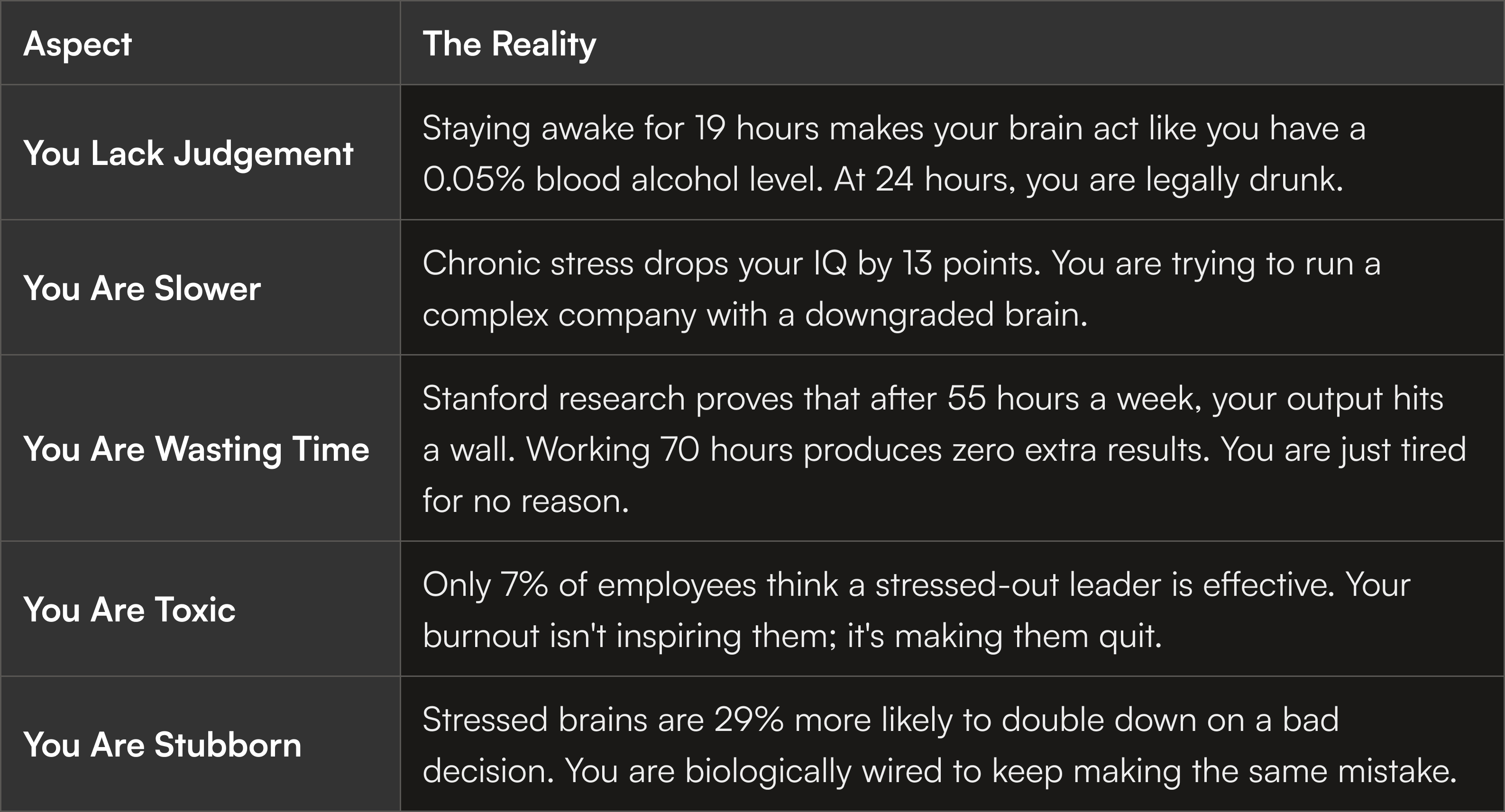
This is not a wellness issue. It is a performance science issue.
Where Winning the Wrong Game Is Considered An Achievement
Last week, in the opening match of the T20 World Cup, defending champions India were staring at humiliation at the hands of minnows USA, with the scorecard reading 46 for 4 when Suryakumar Yadav walked out to bat. By the 13th over, the score was 77 for 6. But then the indomitable SKY produced yet another scintillating knock, scoring 84* in 49 balls. We won the match. He took the ‘player of the match’ honour, one more time. Why is SKY so consistent and dependable? The answer could be found in what he said later. After the innings, Surya said something most founders would never think of: "I felt alone after I played the last series of 2025 against South Africa. I packed my kit bag, and spent a lot of time with family for two weeks. Then started in the new year."
Basically, to power his team’s February mission, he planned a ‘deliberate pause’ in January. No nets. No analysis. Just rest.
Now ask yourself: When was the last time you took two weeks away from your company?
Not in immediate memory, I am sure. And there’s a reason behind it. In cricket, nobody questioned Surya's commitment because he rested. Nobody called him soft because in sports, performance is the only scoreboard. Runs. Strike rate. Trophies. The system rewards what you produce, not what it costs you.
But somewhere in the world of building companies, we swapped the scoreboard with something else. We stopped measuring founders by the Gold Medals (Revenue/Product) and started measuring them by self-inflicted Injuries (Sleep lost/Stress). Narayana Murthy tells young Indians to work seventy hours a week. The room nods. Nobody asks: Seventy hours of what? Producing what? For whom? The hours have become the point. The suffering has become the credential.
This is Performative Suffering - an effort whose primary function isn't to produce outcomes, but to signal commitment.
In sport, you play to win. In startups, we have learned to play to suffer.
Why We Do It: The Peacock’s Tail
Why do highly intelligent founders destroy their own cognitive capacity? Why do we play to suffer?
The answer lies in Costly Signalling Theory.
In 1975, evolutionary biologist Amotz Zahavi asked a deceptively simple question: Why does the peacock carry a tail that makes it harder to survive? It is heavy. It burns calories. It attracts tigers. It is objectively a bad survival strategy.
His answer became the Handicap Principle: A signal is believable precisely because it is costly. The tail proves to the peahen: "I am so genetically fit that I can survive even with this heavy, useless thing on my back."
Your burnout is a Peacock Tail.
In an environment of extreme uncertainty, investors and employees cannot see inside your head to measure your true commitment. They need a proxy.
- It serves no business purpose to work until 3:00 AM.
- It serves no business purpose to skip lunch.
- It serves no business purpose to ignore your family.
But it proves - to investors, to your team, and to yourself - that you are "The Real Deal." The suffering is the certificate. You aren't working hard to build the company; you are working hard to prove you are a Founder.
The Social Lock: Fear and Status
Once this signal is established, a Fear Architecture locks it in.
1. The "Impostor" Tax: 71% of CEOs report feeling like impostors. That's because the higher one rises, the less certain the ground feels beneath them. They are always fighting this feeling - what if they discover I’m just figuring this out like everyone else? When you feel like a fraud, you use suffering as a shield. The logic is unconscious: "I may not be the smartest person here, but if I am the most exhausted, no one can say I don't deserve my seat."
2. Social Comparison Theory explains why this escalates. When your LinkedIn feed is full of peers bragging about the "grind," the baseline for "normal" shifts. If everyone else is signalling 100-hour weeks, resting feels like a dangerous defect.
3. Status Competition Research confirms that in the modern knowledge economy, busyness has replaced leisure as the dominant status symbol. Being the "hardest worker in the room" confers bragging rights. It becomes a game of "Martyrdom Poker": Who slept less? Who sacrificed more?
The winner gains social capital, but they lose the very capacity of thinking clearly needed to actually win the game.
What does it cost you?
The problem with the Olympics of Suffering isn't just that it's performative. For the sceptical leader, the numbers paint a stark picture of lost capacity.
This is not a wellness issue. It is a performance science issue.
The founders’
Olympics of suffering
Where Winning the Wrong Game Is Considered An Achievement
Last week, in the opening match of the T20 World Cup, defending champions India were staring at humiliation at the hands of minnows USA, with the scorecard reading 46 for 4 when Suryakumar Yadav walked out to bat. By the 13th over, the score was 77 for 6. But then the indomitable SKY produced yet another scintillating knock, scoring 84* in 49 balls. We won the match. He took the ‘player of the match’ honour, one more time. Why is SKY so consistent and dependable? The answer could be found in what he said later. After the innings, Surya said something most founders would never think of: "I felt alone after I played the last series of 2025 against South Africa. I packed my kit bag, and spent a lot of time with family for two weeks. Then started in the new year."
Basically, to power his team’s February mission, he planned a ‘deliberate pause’ in January. No nets. No analysis. Just rest.
Now ask yourself: When was the last time you took two weeks away from your company?
Not in immediate memory, I am sure. And there’s a reason behind it. In cricket, nobody questioned Surya's commitment because he rested. Nobody called him soft because in sports, performance is the only scoreboard. Runs. Strike rate. Trophies. The system rewards what you produce, not what it costs you.
But somewhere in the world of building companies, we swapped the scoreboard with something else. We stopped measuring founders by the Gold Medals (Revenue/Product) and started measuring them by self-inflicted Injuries (Sleep lost/Stress). Narayana Murthy tells young Indians to work seventy hours a week. The room nods. Nobody asks: Seventy hours of what? Producing what? For whom? The hours have become the point. The suffering has become the credential.
This is Performative Suffering - an effort whose primary function isn't to produce outcomes, but to signal commitment.
In sport, you play to win. In startups, we have learned to play to suffer.
Why We Do It: The Peacock’s Tail
Why do highly intelligent founders destroy their own cognitive capacity? Why do we play to suffer?
The answer lies in Costly Signalling Theory.
In 1975, evolutionary biologist Amotz Zahavi asked a deceptively simple question: Why does the peacock carry a tail that makes it harder to survive? It is heavy. It burns calories. It attracts tigers. It is objectively a bad survival strategy.
His answer became the Handicap Principle: A signal is believable precisely because it is costly. The tail proves to the peahen: "I am so genetically fit that I can survive even with this heavy, useless thing on my back."
Your burnout is a Peacock Tail.
In an environment of extreme uncertainty, investors and employees cannot see inside your head to measure your true commitment. They need a proxy.
- It serves no business purpose to work until 3:00 AM.
- It serves no business purpose to skip lunch.
- It serves no business purpose to ignore your family.
But it proves - to investors, to your team, and to yourself - that you are "The Real Deal." The suffering is the certificate. You aren't working hard to build the company; you are working hard to prove you are a Founder.
The Social Lock: Fear and Status
Once this signal is established, a Fear Architecture locks it in.
1. The "Impostor" Tax: 71% of CEOs report feeling like impostors. That's because the higher one rises, the less certain the ground feels beneath them. They are always fighting this feeling - what if they discover I’m just figuring this out like everyone else? When you feel like a fraud, you use suffering as a shield. The logic is unconscious: "I may not be the smartest person here, but if I am the most exhausted, no one can say I don't deserve my seat."
2. Social Comparison Theory explains why this escalates. When your LinkedIn feed is full of peers bragging about the "grind," the baseline for "normal" shifts. If everyone else is signalling 100-hour weeks, resting feels like a dangerous defect.
3. Status Competition Research confirms that in the modern knowledge economy, busyness has replaced leisure as the dominant status symbol. Being the "hardest worker in the room" confers bragging rights. It becomes a game of "Martyrdom Poker": Who slept less? Who sacrificed more?
The winner gains social capital, but they lose the very capacity of thinking clearly needed to actually win the game.
What does it cost you?
The problem with the Olympics of Suffering isn't just that it's performative. For the sceptical leader, the numbers paint a stark picture of lost capacity.
This is not a wellness issue. It is a performance science issue.

Resonating with this philosophy?
Join the smartest founders mastering the inner game to face the unknown. Read by YC & Sequoia.

And Yet You Can't Quit The Circus..
If the costs are so clear, why can’t we stop?
1. We Value What We Suffer For (Effort Justification) Research by Aronson and Mills revealed a dark quirk of human nature: We value what we suffer for. If you have "bled" for your company, your brain refuses to accept that an easier path exists. To admit that rest is a weapon is to admit that your past suffering was a waste.
2. Intelligence as a Trap (Identity-Protective Cognition) Research by Dan Kahan suggests that highly intelligent individuals are better at rationalising their identity-driven beliefs. If your identity is fused with "The Grinder," you will use your high IQ to construct a fortress of logic around your martyrdom. You will find the one outlier example (Elon Musk) to justify your behaviour, ignoring the thousands of failures caused by burnout.
The Solution: Oscillation
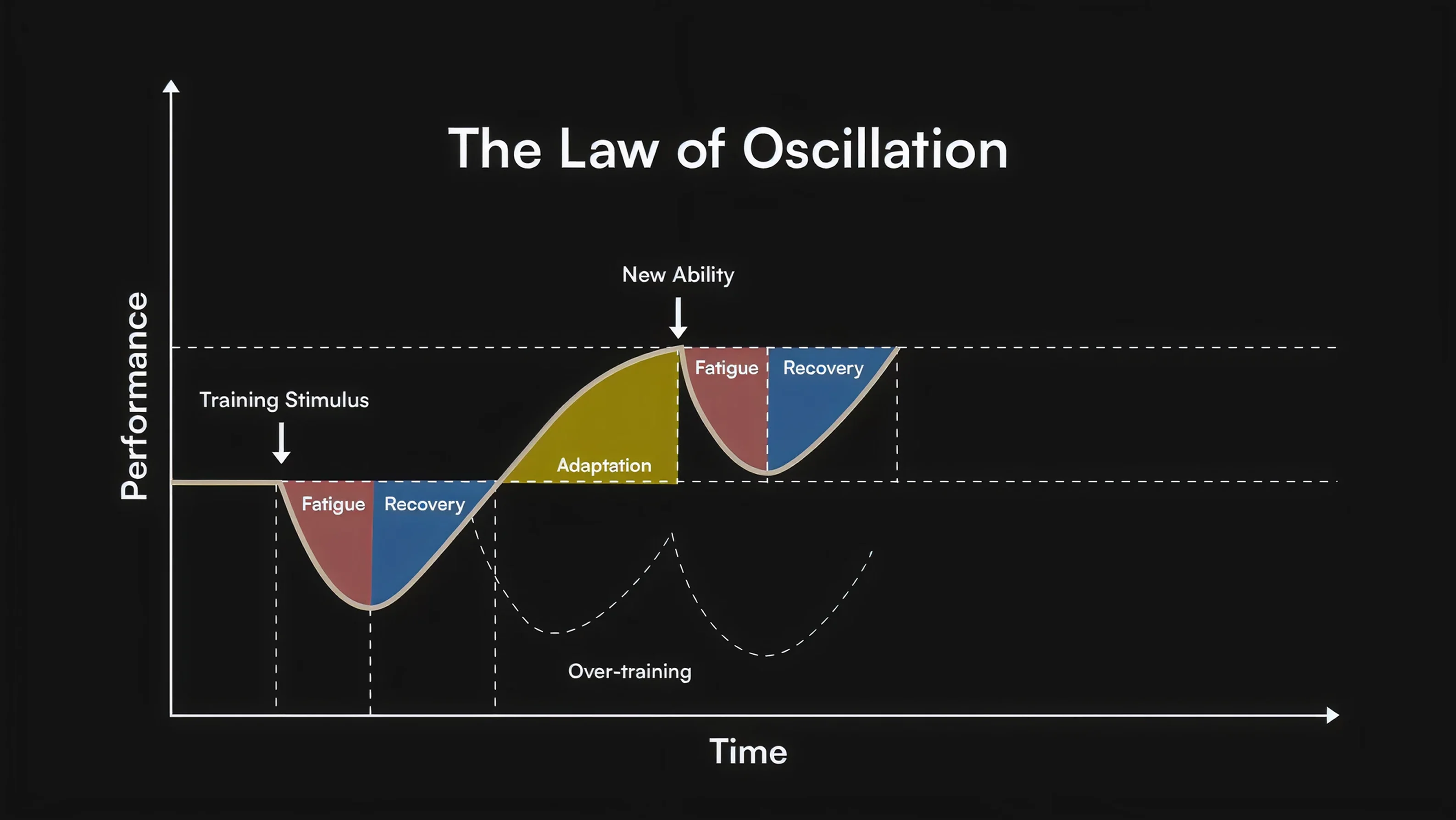
If the "Linear Grind" destroys capacity, what is the alternative?
We must return to Suryakumar Yadav. We must return to the Athlete’s Model.
Elite performers do not optimise for suffering. They optimise for Recovery. They understand the fundamental biological law of Oscillation: Human systems are designed to pulsate, not function as a flatline.
- The Factory Model (Startups): Machines run 24/7. If they stop, you lose money.
- The Athlete Model (Humans): Muscles tear when you lift. They only grow when you rest. This is the principle of Supercompensation.
1. Macro-Oscillation: Like SKY, you need an "off-season" after a sprint. Stepping away isn't quitting; it's resetting the Allostatic Load, the cumulative "wear and tear" on the body and brain resulting from chronic, long-term exposure to stress.
2. Micro-Oscillation: Work in 90-minute sprints, then fully disengage.
3. True Rest: Scrolling Twitter is not rest. That is "Junk Stimulation". True rest comes by boring your brain (walking, sleeping, meditating) to reactivate the Default Mode Network, an interconnected brain network where insight happens.
Conclusion: The Exit
The logic of Oscillation is irrefutable.
Suryakumar Yadav didn't get back in form by showing the world how much he could suffer in the nets. He got back in form by respecting his biology.
You have a choice.
You can continue to signal your commitment by frying your nervous system and clinging to the sunk cost of your pain to win the Olympics of Suffering.
Or, you can commit to winning the actual game.
For those who can let go of the guilt: Go, be Surya.

To be continued…
A small favor...
I don't run ads. If this brought clarity, the biggest favor you can do is subscribe below.



.svg)

.svg)