
Steve Jobs Wasn't Complete.
Neither Are You

Stop trying to become a 'Polymath Founder', Start 'designing' your success
Executive Summary
To believe that authentic Desire, coupled with Intelligence and Effort, brings sure success is flawed thinking. Sustainable success cannot rely on the volatile chemistry of "wanting." Nor does "passion" fuel entrepreneurship, as is the popular belief, because science suggests otherwise. Passion is a dopamine response, a biological flare designed for short-term pursuit, not the 7-10 year journey that meaningful ventures require. Success, in fact, requires three elements together: Desire (authentic drive), Design (who you are + the environment you build), and Effort (sustained practice over years), and it begins with auditing your Desire to succeed. This article offers a rigorous audit to distinguish Fabricated Desire from Authentic Drive, then provides a framework to engineer your Design, and finally, design your effort around your weaknesses using neuroscience and Eastern philosophy.
The flawed equation that makes Steve Jobs look a Superman
We say Steve Jobs "willed" Apple into existence. Elon Musk "refused to give up" on Tesla. Jeff Bezos "believed" in Amazon when everyone doubted. The narrative arc is always the same:
Authentic Desire + High Intelligence = Inevitable Success
This belief feels true because both inputs are true.
Since everyone reading this article is intelligent enough and motivated as well, there must be something else missing in the equation.
A clue to this missing link lies in how we tell success stories.
I hear them every morning, with my Americano, as I watch the same scene unfold across coffee shops in Bombay, Hyderabad, and Bangalore. Brilliant founders working 80-hour weeks, trying to force their will into success. The narrative in their head tells them the solution is simple: You just need to want it more. Become a "Polymath Founder" who's good at everything. The mythology around successful entrepreneurs erases everything else.
Here's what the data reveals:
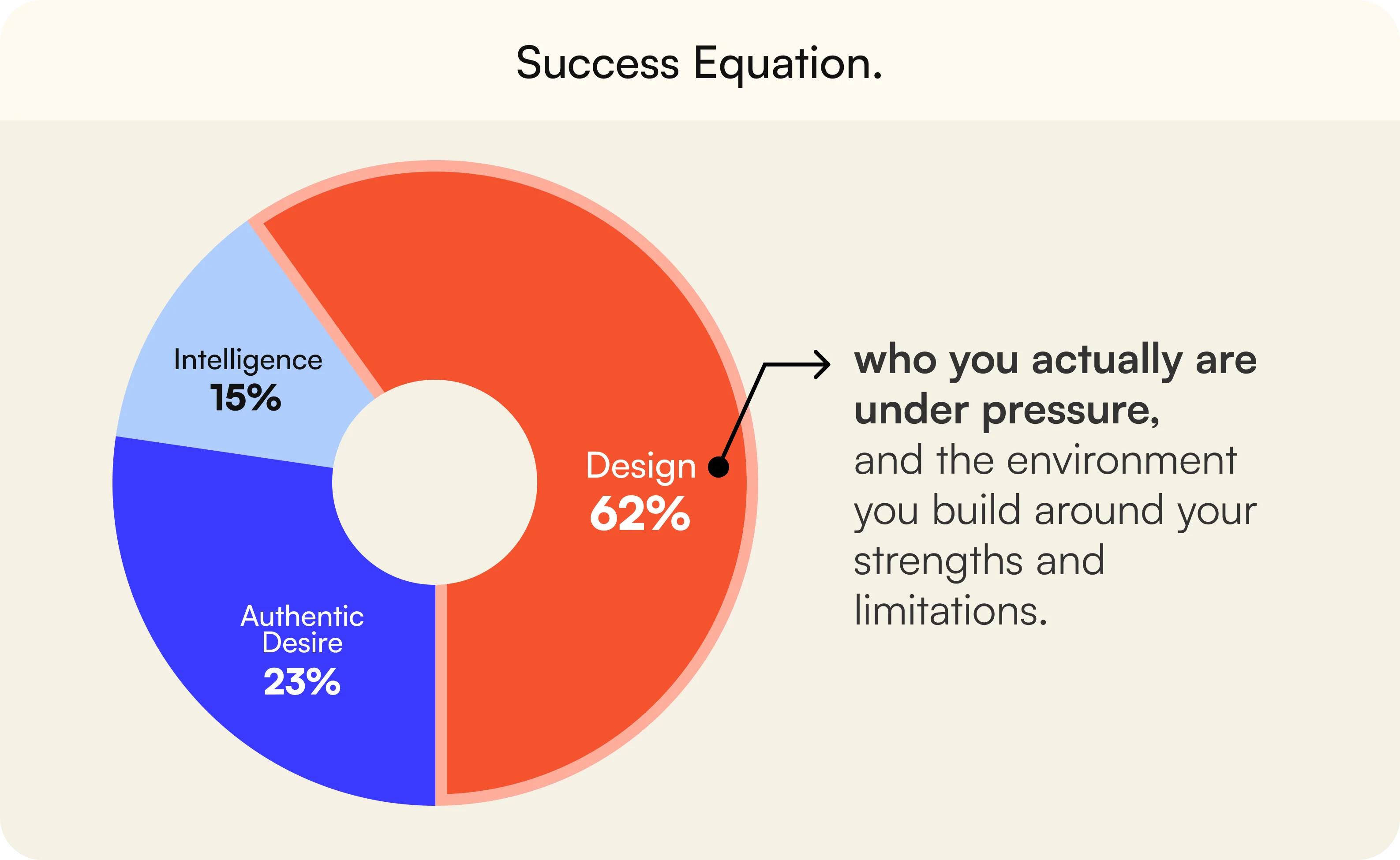
Authentic desire explains only 23% of entrepreneurial success. Intelligence explains another 15%. The remaining 62% comes from Design factors - who you actually are under pressure, and the environment you build around your strengths and limitations.
The fact that you're failing despite authentic desire and high intelligence doesn't mean you're not cut out for this. It means you haven't properly designed for success.
This is the "smart person's trap." You're stuck, but you can't figure out why.
Your authentic desire matters. But desire without Design is just an expensive fantasy.
So how do you bridge that gap? Through a three-step process that moves you from wanting to manifestation.
Step 1: Audit Your Desire
Run The Anonymity Test
Before you can design anything, you need to know if your desire is authentic, because your brain might be lying to you about what you want.
Ask yourself: "If I could build this company and achieve this outcome, but no one could ever know I was the founder - zero public credit, zero status signal - would I still do it?"
If your motivation collapses without the LinkedIn update, it's costly signalling, not authentic drive. Mimetic desires require an audience. Authentic drives function in the dark.
Why Your Brain Lies About What You Want
We assume that if we crave something intensely, we're "meant" to do it. However, neuroscientist Kent Berridge discovered a disturbing flaw in the human operating system: "Wanting" and "Liking" are controlled by distinct neural pathways.
The "Wanting" system (dopamine) is vast and robust. It evolved to enable our ancestors to continue hunting and gathering. The "Liking" system (opioids/endocannabinoids) is tiny, fragile, and creates the actual sensation of satisfaction. Wanting something does not mean you will also like the grind required to achieve it.
This means you can biologically obsess over a goal - like becoming a CEO or exiting for $100M - without possessing the neural capacity to accept the daily reality of it.
You're running on legacy code optimised for the African savanna, where constant dissatisfaction kept you alive. In the modern world, this creates what psychologists call the "Arrival Fallacy." You chase the costly signal of being a "Founder" because it proves your status to the tribe, and not because you actually like the hard work that goes into it.
If we could look past the polite reasons people give for starting companies - "I want to change the world" - we'd often find a simpler truth: They don't want the job; they want the identity.
If you pass this test, your desire is real. But that's only the first step. Next, you need to understand your Design, which has two components.
Step 2: Follow Your Blisters (Tapas)
So your desire is authentic. Good. But now we face a more pressing question: Are you equipped for the daily realities of this work?
We're told to "follow our passion," but passion is a volatile force. It burns bright and fades fast. A far more reliable metric for a ten-year journey is to "Follow Your Blisters."
In Sanskrit philosophy, there's a critical distinction between two types of pain:
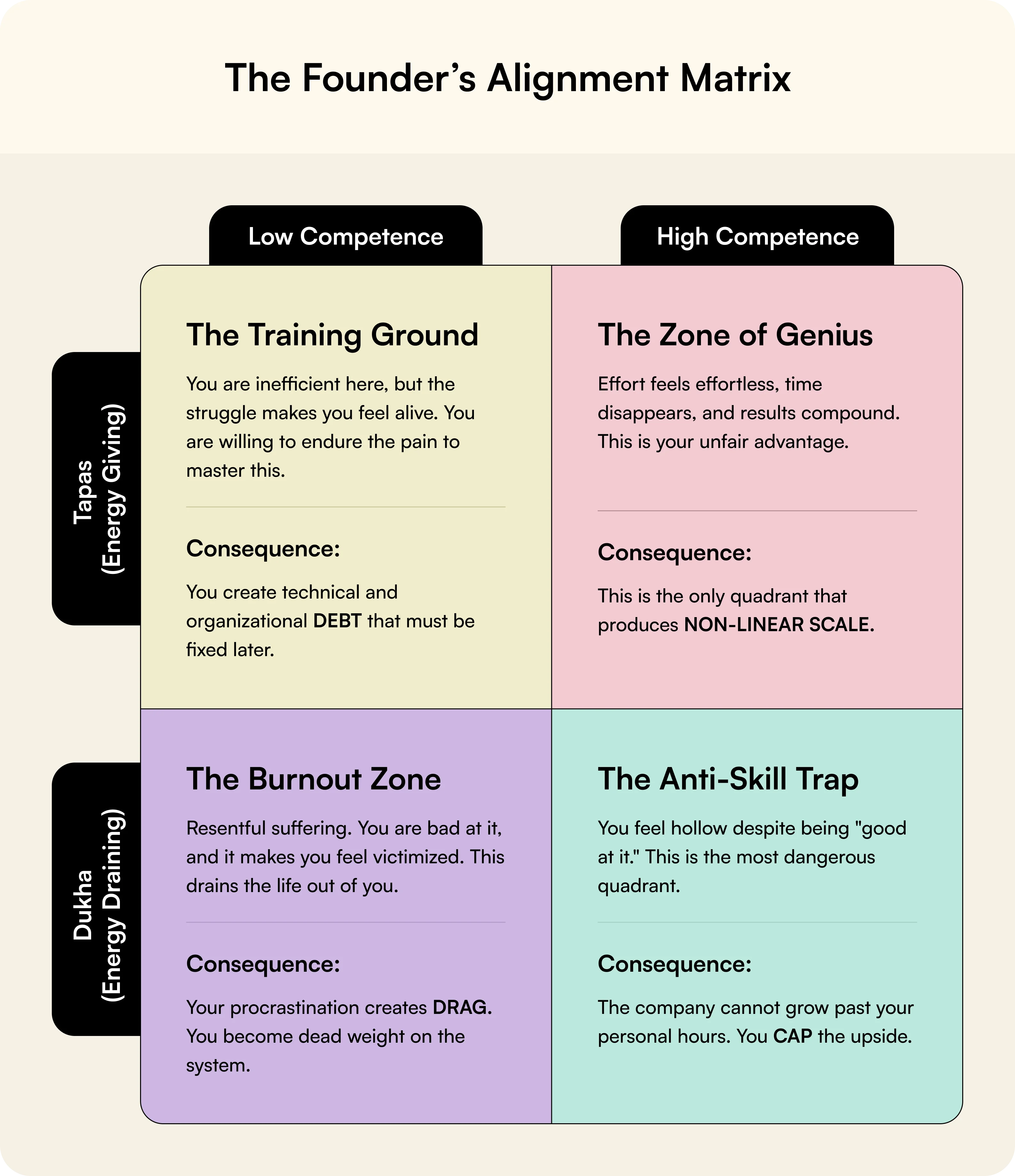
Dukha (Resentful Suffering): Pain that drains you. It makes you feel victimised. It creates a somatic contraction in your body - tightness in the chest, dread in the gut.
Tapas (Energising Heat): Voluntary discipline. Pain you choose because it strengthens you. The struggle that makes you feel alive.
Every founder's path involves pain. The diagnostic question isn't "What do I enjoy?" It's: "What pain am I willing to endure for the next ten years?"
Look at What You Endure
Your Tapas: Wha t hard work do you voluntarily seek out? What tedious details do you tolerate without complaint? What problems do you solve even when nobody pays you?
Your Anti-Skills: What crucial work makes you resentful? What drains you even when you're successful at it?
For me, during CreditVidya, my Tapas was deep strategic thinking, product architecture, and system design. I could do it for ten hours and leave energised. My Anti-Skills were banking compliance, regulatory meetings, and administrative operations. I could do them, but they hollowed me out.
The "Founder's Lie" told me I just needed to discipline myself to get better at compliance.
Not a sound strategy.
Now you understand your Internal Design - your Tapas and Anti-Skills. But here's where most founders get stuck: They think the solution is to "fix" their Anti-Skills through discipline and grinding.
That's exactly wrong. You don't fix your design. You build an environment around it.
Step 3: Engineer Your Environment (Design)
You don't have to be complete. You have to design an environment that makes you complete.
The solo genius - like Steve Jobs or Elon Musk - who does it all is a romantic myth. The reality is that these figures were masters of designing their environment. They didn't fix their weaknesses; they built ecosystems that made their weaknesses irrelevant.
If you have audited your Desire and put in Effort (Tapas), but you're still stuck, you're missing Design - the environment that bridges the gap between who you are and what success requires.
Here are six ways to engineer your External Design:
Option 1: Complementary Co-Founder
When I incorporated CreditVidya, I faced this exact wall. My desire was authentic because I passed the Anonymity Test. But the daily reality was killing me. I thought I just needed to be tougher. But I was wrong.
My Internal Design was strategy, product, and systems thinking. I wasn't lacking grit, but the right External Design.
Then I found Rajiv.
Rajiv didn't just "tolerate" banking operations. He loved them. Where I saw red tape, he saw strategic chess. Where I saw exhausting small talk, he saw relationship building.
More crucially, he needed what I had as much as I needed what he had.
- My Tapas: Product strategy, tech architecture, strategic vision
- His Tapas: Operations, compliance, banking relationships, regulatory navigation
We didn't just "help" each other. We created a complete organism from two incomplete people. This required ego surrender. I had to accept that Rajiv would make operational decisions I didn't fully understand. He had to trust my technical choices he couldn't evaluate. But that surrender created efficiency that solo grinding never could.
Y Combinator's data across 5,000+ companies confirms this pattern: The most successful startups have founding teams of 2-3 people with orthogonal skill sets. But a co-founder isn't the only way to design your environment.
Option 2: Strategic Early Hires
Brian Chesky (Airbnb) is brilliant at product vision and brand. He's terrible at operational scaling. Instead of forcing himself to become great at operations, he brought in Nathan Blecharczyk early, someone whose Tapas matched Brian’s Dukha.
Option 3: Role Repositioning
Naval Ravikant is a brilliant strategic thinker but hates operational management. His environmental design: He became an angel investor and advisor, not an operating CEO. He designed a role where his strengths (pattern recognition, strategic insight) are the entire job, not a fraction of it.
Option 4: Ecosystem Building (Sangha)
In yogic philosophy, there's the concept of sangha - the community of practice. They were part of gurukuls where different masters contributed different expertise.
Beyond co-founders, you need:
- Domain advisors who open doors you can't.
- Technical specialists who solve problems you find boring.
- Operational hires who love the admin details that drain you.
Option 5: Capital Structure Alignment
Some business models require venture scale; others die under venture pressure. Jason Fried and DHH at Basecamp consciously chose bootstrapping because their Internal Design was building calm, sustainable products. Venture pressure would have forced them into work misaligned with their nature.
Option 6: Cultural Systems
Amazon's six-page memo culture exists because Bezos understood his Internal Design. He's not the person who should make decisions in the moment. He's the person who should think deeply before meetings. So they designed a system where everyone reads in silence for 30 minutes. The environment supports the design.
Successful founders don't just work hard, but design the conditions where their specific strengths can produce disproportionate value. The most successful founders use multiple forms of External Design simultaneously.
Conclusion: The Real Equation
True ambition is not the ability to suffer to achieve a standard goal, but the courage to design a reality that fits who you actually are.
Taoists call it Wu Wei - effortless action. It means working with the grain of your nature, designing an environment that amplifies your strengths rather than fighting your limitations.
You don't have to be complete, but smart enough to design around your incompleteness.
Stop trying to want it more. Willpower is a finite resource. Good design is infinite.
Stop grinding harder. Start designing smarter.
Stop chasing the fantasy. Start designing reality.
The reality is that sustainable success = Audited Desire + Effort (Tapas) + Design
Make all three work together for you, and that changes everything.
Stop trying to become a 'Polymath Founder', Start 'designing' your success
Executive Summary
To believe that authentic Desire, coupled with Intelligence and Effort, brings sure success is flawed thinking. Sustainable success cannot rely on the volatile chemistry of "wanting." Nor does "passion" fuel entrepreneurship, as is the popular belief, because science suggests otherwise. Passion is a dopamine response, a biological flare designed for short-term pursuit, not the 7-10 year journey that meaningful ventures require. Success, in fact, requires three elements together: Desire (authentic drive), Design (who you are + the environment you build), and Effort (sustained practice over years), and it begins with auditing your Desire to succeed. This article offers a rigorous audit to distinguish Fabricated Desire from Authentic Drive, then provides a framework to engineer your Design, and finally, design your effort around your weaknesses using neuroscience and Eastern philosophy.
The flawed equation that makes Steve Jobs look a Superman
We say Steve Jobs "willed" Apple into existence. Elon Musk "refused to give up" on Tesla. Jeff Bezos "believed" in Amazon when everyone doubted. The narrative arc is always the same:
Authentic Desire + High Intelligence = Inevitable Success
This belief feels true because both inputs are true.
Since everyone reading this article is intelligent enough and motivated as well, there must be something else missing in the equation.
A clue to this missing link lies in how we tell success stories.
I hear them every morning, with my Americano, as I watch the same scene unfold across coffee shops in Bombay, Hyderabad, and Bangalore. Brilliant founders working 80-hour weeks, trying to force their will into success. The narrative in their head tells them the solution is simple: You just need to want it more. Become a "Polymath Founder" who's good at everything. The mythology around successful entrepreneurs erases everything else.
Here's what the data reveals:
Authentic desire explains only 23% of entrepreneurial success. Intelligence explains another 15%. The remaining 62% comes from Design factors - who you actually are under pressure, and the environment you build around your strengths and limitations.
The fact that you're failing despite authentic desire and high intelligence doesn't mean you're not cut out for this. It means you haven't properly designed for success.
This is the "smart person's trap." You're stuck, but you can't figure out why.
Your authentic desire matters. But desire without Design is just an expensive fantasy.
So how do you bridge that gap? Through a three-step process that moves you from wanting to manifestation.
Step 1: Audit Your Desire
Run The Anonymity Test
Before you can design anything, you need to know if your desire is authentic, because your brain might be lying to you about what you want.
Ask yourself: "If I could build this company and achieve this outcome, but no one could ever know I was the founder - zero public credit, zero status signal - would I still do it?"
If your motivation collapses without the LinkedIn update, it's costly signalling, not authentic drive. Mimetic desires require an audience. Authentic drives function in the dark.
Why Your Brain Lies About What You Want
We assume that if we crave something intensely, we're "meant" to do it. However, neuroscientist Kent Berridge discovered a disturbing flaw in the human operating system: "Wanting" and "Liking" are controlled by distinct neural pathways.
The "Wanting" system (dopamine) is vast and robust. It evolved to enable our ancestors to continue hunting and gathering. The "Liking" system (opioids/endocannabinoids) is tiny, fragile, and creates the actual sensation of satisfaction. Wanting something does not mean you will also like the grind required to achieve it.
This means you can biologically obsess over a goal - like becoming a CEO or exiting for $100M - without possessing the neural capacity to accept the daily reality of it.
You're running on legacy code optimised for the African savanna, where constant dissatisfaction kept you alive. In the modern world, this creates what psychologists call the "Arrival Fallacy." You chase the costly signal of being a "Founder" because it proves your status to the tribe, and not because you actually like the hard work that goes into it.
If we could look past the polite reasons people give for starting companies - "I want to change the world" - we'd often find a simpler truth: They don't want the job; they want the identity.
If you pass this test, your desire is real. But that's only the first step. Next, you need to understand your Design, which has two components.
Step 2: Follow Your Blisters (Tapas)
So your desire is authentic. Good. But now we face a more pressing question: Are you equipped for the daily realities of this work?
We're told to "follow our passion," but passion is a volatile force. It burns bright and fades fast. A far more reliable metric for a ten-year journey is to "Follow Your Blisters."
In Sanskrit philosophy, there's a critical distinction between two types of pain:
Dukha (Resentful Suffering): Pain that drains you. It makes you feel victimised. It creates a somatic contraction in your body - tightness in the chest, dread in the gut.
Tapas (Energising Heat): Voluntary discipline. Pain you choose because it strengthens you. The struggle that makes you feel alive.
Every founder's path involves pain. The diagnostic question isn't "What do I enjoy?" It's: "What pain am I willing to endure for the next ten years?"
Look at What You Endure
Your Tapas: Wha t hard work do you voluntarily seek out? What tedious details do you tolerate without complaint? What problems do you solve even when nobody pays you?
Your Anti-Skills: What crucial work makes you resentful? What drains you even when you're successful at it?
For me, during CreditVidya, my Tapas was deep strategic thinking, product architecture, and system design. I could do it for ten hours and leave energised. My Anti-Skills were banking compliance, regulatory meetings, and administrative operations. I could do them, but they hollowed me out.
The "Founder's Lie" told me I just needed to discipline myself to get better at compliance.
Not a sound strategy.
Now you understand your Internal Design - your Tapas and Anti-Skills. But here's where most founders get stuck: They think the solution is to "fix" their Anti-Skills through discipline and grinding.
That's exactly wrong. You don't fix your design. You build an environment around it.
Step 3: Engineer Your Environment (Design)
You don't have to be complete. You have to design an environment that makes you complete.
The solo genius - like Steve Jobs or Elon Musk - who does it all is a romantic myth. The reality is that these figures were masters of designing their environment. They didn't fix their weaknesses; they built ecosystems that made their weaknesses irrelevant.
If you have audited your Desire and put in Effort (Tapas), but you're still stuck, you're missing Design - the environment that bridges the gap between who you are and what success requires.
Here are six ways to engineer your External Design:
Option 1: Complementary Co-Founder
When I incorporated CreditVidya, I faced this exact wall. My desire was authentic because I passed the Anonymity Test. But the daily reality was killing me. I thought I just needed to be tougher. But I was wrong.
My Internal Design was strategy, product, and systems thinking. I wasn't lacking grit, but the right External Design.
Then I found Rajiv.
Rajiv didn't just "tolerate" banking operations. He loved them. Where I saw red tape, he saw strategic chess. Where I saw exhausting small talk, he saw relationship building.
More crucially, he needed what I had as much as I needed what he had.
- My Tapas: Product strategy, tech architecture, strategic vision
- His Tapas: Operations, compliance, banking relationships, regulatory navigation
We didn't just "help" each other. We created a complete organism from two incomplete people. This required ego surrender. I had to accept that Rajiv would make operational decisions I didn't fully understand. He had to trust my technical choices he couldn't evaluate. But that surrender created efficiency that solo grinding never could.
Y Combinator's data across 5,000+ companies confirms this pattern: The most successful startups have founding teams of 2-3 people with orthogonal skill sets. But a co-founder isn't the only way to design your environment.
Option 2: Strategic Early Hires
Brian Chesky (Airbnb) is brilliant at product vision and brand. He's terrible at operational scaling. Instead of forcing himself to become great at operations, he brought in Nathan Blecharczyk early, someone whose Tapas matched Brian’s Dukha.
Option 3: Role Repositioning
Naval Ravikant is a brilliant strategic thinker but hates operational management. His environmental design: He became an angel investor and advisor, not an operating CEO. He designed a role where his strengths (pattern recognition, strategic insight) are the entire job, not a fraction of it.
Option 4: Ecosystem Building (Sangha)
In yogic philosophy, there's the concept of sangha - the community of practice. They were part of gurukuls where different masters contributed different expertise.
Beyond co-founders, you need:
- Domain advisors who open doors you can't.
- Technical specialists who solve problems you find boring.
- Operational hires who love the admin details that drain you.
Option 5: Capital Structure Alignment
Some business models require venture scale; others die under venture pressure. Jason Fried and DHH at Basecamp consciously chose bootstrapping because their Internal Design was building calm, sustainable products. Venture pressure would have forced them into work misaligned with their nature.
Option 6: Cultural Systems
Amazon's six-page memo culture exists because Bezos understood his Internal Design. He's not the person who should make decisions in the moment. He's the person who should think deeply before meetings. So they designed a system where everyone reads in silence for 30 minutes. The environment supports the design.
Successful founders don't just work hard, but design the conditions where their specific strengths can produce disproportionate value. The most successful founders use multiple forms of External Design simultaneously.
Conclusion: The Real Equation
True ambition is not the ability to suffer to achieve a standard goal, but the courage to design a reality that fits who you actually are.
Taoists call it Wu Wei - effortless action. It means working with the grain of your nature, designing an environment that amplifies your strengths rather than fighting your limitations.
You don't have to be complete, but smart enough to design around your incompleteness.
Stop trying to want it more. Willpower is a finite resource. Good design is infinite.
Stop grinding harder. Start designing smarter.
Stop chasing the fantasy. Start designing reality.
The reality is that sustainable success = Audited Desire + Effort (Tapas) + Design
Make all three work together for you, and that changes everything.
Steve Jobs Wasn't Complete.
Neither Are You
Stop trying to become a 'Polymath Founder', Start 'designing' your success
Executive Summary
To believe that authentic Desire, coupled with Intelligence and Effort, brings sure success is flawed thinking. Sustainable success cannot rely on the volatile chemistry of "wanting." Nor does "passion" fuel entrepreneurship, as is the popular belief, because science suggests otherwise. Passion is a dopamine response, a biological flare designed for short-term pursuit, not the 7-10 year journey that meaningful ventures require. Success, in fact, requires three elements together: Desire (authentic drive), Design (who you are + the environment you build), and Effort (sustained practice over years), and it begins with auditing your Desire to succeed. This article offers a rigorous audit to distinguish Fabricated Desire from Authentic Drive, then provides a framework to engineer your Design, and finally, design your effort around your weaknesses using neuroscience and Eastern philosophy.
The flawed equation that makes Steve Jobs look a Superman
We say Steve Jobs "willed" Apple into existence. Elon Musk "refused to give up" on Tesla. Jeff Bezos "believed" in Amazon when everyone doubted. The narrative arc is always the same:
Authentic Desire + High Intelligence = Inevitable Success
This belief feels true because both inputs are true.
Since everyone reading this article is intelligent enough and motivated as well, there must be something else missing in the equation.
A clue to this missing link lies in how we tell success stories.
I hear them every morning, with my Americano, as I watch the same scene unfold across coffee shops in Bombay, Hyderabad, and Bangalore. Brilliant founders working 80-hour weeks, trying to force their will into success. The narrative in their head tells them the solution is simple: You just need to want it more. Become a "Polymath Founder" who's good at everything. The mythology around successful entrepreneurs erases everything else.
Here's what the data reveals:
Authentic desire explains only 23% of entrepreneurial success. Intelligence explains another 15%. The remaining 62% comes from Design factors - who you actually are under pressure, and the environment you build around your strengths and limitations.
The fact that you're failing despite authentic desire and high intelligence doesn't mean you're not cut out for this. It means you haven't properly designed for success.
This is the "smart person's trap." You're stuck, but you can't figure out why.
Your authentic desire matters. But desire without Design is just an expensive fantasy.
So how do you bridge that gap? Through a three-step process that moves you from wanting to manifestation.
Step 1: Audit Your Desire
Run The Anonymity Test
Before you can design anything, you need to know if your desire is authentic, because your brain might be lying to you about what you want.
Ask yourself: "If I could build this company and achieve this outcome, but no one could ever know I was the founder - zero public credit, zero status signal - would I still do it?"
If your motivation collapses without the LinkedIn update, it's costly signalling, not authentic drive. Mimetic desires require an audience. Authentic drives function in the dark.
Why Your Brain Lies About What You Want
We assume that if we crave something intensely, we're "meant" to do it. However, neuroscientist Kent Berridge discovered a disturbing flaw in the human operating system: "Wanting" and "Liking" are controlled by distinct neural pathways.
The "Wanting" system (dopamine) is vast and robust. It evolved to enable our ancestors to continue hunting and gathering. The "Liking" system (opioids/endocannabinoids) is tiny, fragile, and creates the actual sensation of satisfaction. Wanting something does not mean you will also like the grind required to achieve it.
This means you can biologically obsess over a goal - like becoming a CEO or exiting for $100M - without possessing the neural capacity to accept the daily reality of it.
You're running on legacy code optimised for the African savanna, where constant dissatisfaction kept you alive. In the modern world, this creates what psychologists call the "Arrival Fallacy." You chase the costly signal of being a "Founder" because it proves your status to the tribe, and not because you actually like the hard work that goes into it.
If we could look past the polite reasons people give for starting companies - "I want to change the world" - we'd often find a simpler truth: They don't want the job; they want the identity.
If you pass this test, your desire is real. But that's only the first step. Next, you need to understand your Design, which has two components.
Step 2: Follow Your Blisters (Tapas)
So your desire is authentic. Good. But now we face a more pressing question: Are you equipped for the daily realities of this work?
We're told to "follow our passion," but passion is a volatile force. It burns bright and fades fast. A far more reliable metric for a ten-year journey is to "Follow Your Blisters."
In Sanskrit philosophy, there's a critical distinction between two types of pain:
Dukha (Resentful Suffering): Pain that drains you. It makes you feel victimised. It creates a somatic contraction in your body - tightness in the chest, dread in the gut.
Tapas (Energising Heat): Voluntary discipline. Pain you choose because it strengthens you. The struggle that makes you feel alive.
Every founder's path involves pain. The diagnostic question isn't "What do I enjoy?" It's: "What pain am I willing to endure for the next ten years?"
Look at What You Endure
Your Tapas: Wha t hard work do you voluntarily seek out? What tedious details do you tolerate without complaint? What problems do you solve even when nobody pays you?
Your Anti-Skills: What crucial work makes you resentful? What drains you even when you're successful at it?
For me, during CreditVidya, my Tapas was deep strategic thinking, product architecture, and system design. I could do it for ten hours and leave energised. My Anti-Skills were banking compliance, regulatory meetings, and administrative operations. I could do them, but they hollowed me out.
The "Founder's Lie" told me I just needed to discipline myself to get better at compliance.
Not a sound strategy.
Now you understand your Internal Design - your Tapas and Anti-Skills. But here's where most founders get stuck: They think the solution is to "fix" their Anti-Skills through discipline and grinding.
That's exactly wrong. You don't fix your design. You build an environment around it.
Step 3: Engineer Your Environment (Design)
You don't have to be complete. You have to design an environment that makes you complete.
The solo genius - like Steve Jobs or Elon Musk - who does it all is a romantic myth. The reality is that these figures were masters of designing their environment. They didn't fix their weaknesses; they built ecosystems that made their weaknesses irrelevant.
If you have audited your Desire and put in Effort (Tapas), but you're still stuck, you're missing Design - the environment that bridges the gap between who you are and what success requires.
Here are six ways to engineer your External Design:
Option 1: Complementary Co-Founder
When I incorporated CreditVidya, I faced this exact wall. My desire was authentic because I passed the Anonymity Test. But the daily reality was killing me. I thought I just needed to be tougher. But I was wrong.
My Internal Design was strategy, product, and systems thinking. I wasn't lacking grit, but the right External Design.
Then I found Rajiv.
Rajiv didn't just "tolerate" banking operations. He loved them. Where I saw red tape, he saw strategic chess. Where I saw exhausting small talk, he saw relationship building.
More crucially, he needed what I had as much as I needed what he had.
- My Tapas: Product strategy, tech architecture, strategic vision
- His Tapas: Operations, compliance, banking relationships, regulatory navigation
We didn't just "help" each other. We created a complete organism from two incomplete people. This required ego surrender. I had to accept that Rajiv would make operational decisions I didn't fully understand. He had to trust my technical choices he couldn't evaluate. But that surrender created efficiency that solo grinding never could.
Y Combinator's data across 5,000+ companies confirms this pattern: The most successful startups have founding teams of 2-3 people with orthogonal skill sets. But a co-founder isn't the only way to design your environment.
Option 2: Strategic Early Hires
Brian Chesky (Airbnb) is brilliant at product vision and brand. He's terrible at operational scaling. Instead of forcing himself to become great at operations, he brought in Nathan Blecharczyk early, someone whose Tapas matched Brian’s Dukha.
Option 3: Role Repositioning
Naval Ravikant is a brilliant strategic thinker but hates operational management. His environmental design: He became an angel investor and advisor, not an operating CEO. He designed a role where his strengths (pattern recognition, strategic insight) are the entire job, not a fraction of it.
Option 4: Ecosystem Building (Sangha)
In yogic philosophy, there's the concept of sangha - the community of practice. They were part of gurukuls where different masters contributed different expertise.
Beyond co-founders, you need:
- Domain advisors who open doors you can't.
- Technical specialists who solve problems you find boring.
- Operational hires who love the admin details that drain you.
Option 5: Capital Structure Alignment
Some business models require venture scale; others die under venture pressure. Jason Fried and DHH at Basecamp consciously chose bootstrapping because their Internal Design was building calm, sustainable products. Venture pressure would have forced them into work misaligned with their nature.
Option 6: Cultural Systems
Amazon's six-page memo culture exists because Bezos understood his Internal Design. He's not the person who should make decisions in the moment. He's the person who should think deeply before meetings. So they designed a system where everyone reads in silence for 30 minutes. The environment supports the design.
Successful founders don't just work hard, but design the conditions where their specific strengths can produce disproportionate value. The most successful founders use multiple forms of External Design simultaneously.
Conclusion: The Real Equation
True ambition is not the ability to suffer to achieve a standard goal, but the courage to design a reality that fits who you actually are.
Taoists call it Wu Wei - effortless action. It means working with the grain of your nature, designing an environment that amplifies your strengths rather than fighting your limitations.
You don't have to be complete, but smart enough to design around your incompleteness.
Stop trying to want it more. Willpower is a finite resource. Good design is infinite.
Stop grinding harder. Start designing smarter.
Stop chasing the fantasy. Start designing reality.
The reality is that sustainable success = Audited Desire + Effort (Tapas) + Design
Make all three work together for you, and that changes everything.

Resonating with this philosophy?
Join the smartest founders mastering the inner game to face the unknown. Read by YC & Sequoia.


To be continued…
A small favor...
I don't run ads. If this brought clarity, the biggest favor you can do is subscribe below.

.webp)

.svg)

.svg)