
When Success Still Feels Empty
Why effort and rest are not enough, and the 20 minute audit that changes everything.
Wellness advocate Rich Roll spent years walking the halls of his law firm, feeling a constant, low-level confusion. It wasn’t about the work - he was good at it. What puzzled him was that while others seemed to genuinely enjoy it, he could not say the same for himself. Still, he kept going. He had once been a world-ranked swimmer at Stanford, but by age 40, he couldn’t climb the stairs in his own house. What happened in between is the story I want to tell. But before that, I need to admit that my story is no different.
Six months after CreditVidya was acquired by CRED, I sat in a Bangalore coffee shop across from someone who asked what I would build next. It was a fair question. I had options, capital, and reputation. But suddenly, and oddly, I didn’t have an answer. It wasn’t that I didn’t know what to say, but something inside me had gone quiet in a way I had never felt before.
That quiet is what this essay is about.
For a decade, I kept telling myself the reward for my hard work was just around the corner. Ek baar MBA ho jaaye, bus life set. Ek baar acquisition ho jaaye, bus life set. The MBA happened. The acquisition happened. But the feeling I was promised never came.

The Rider and the Elephant
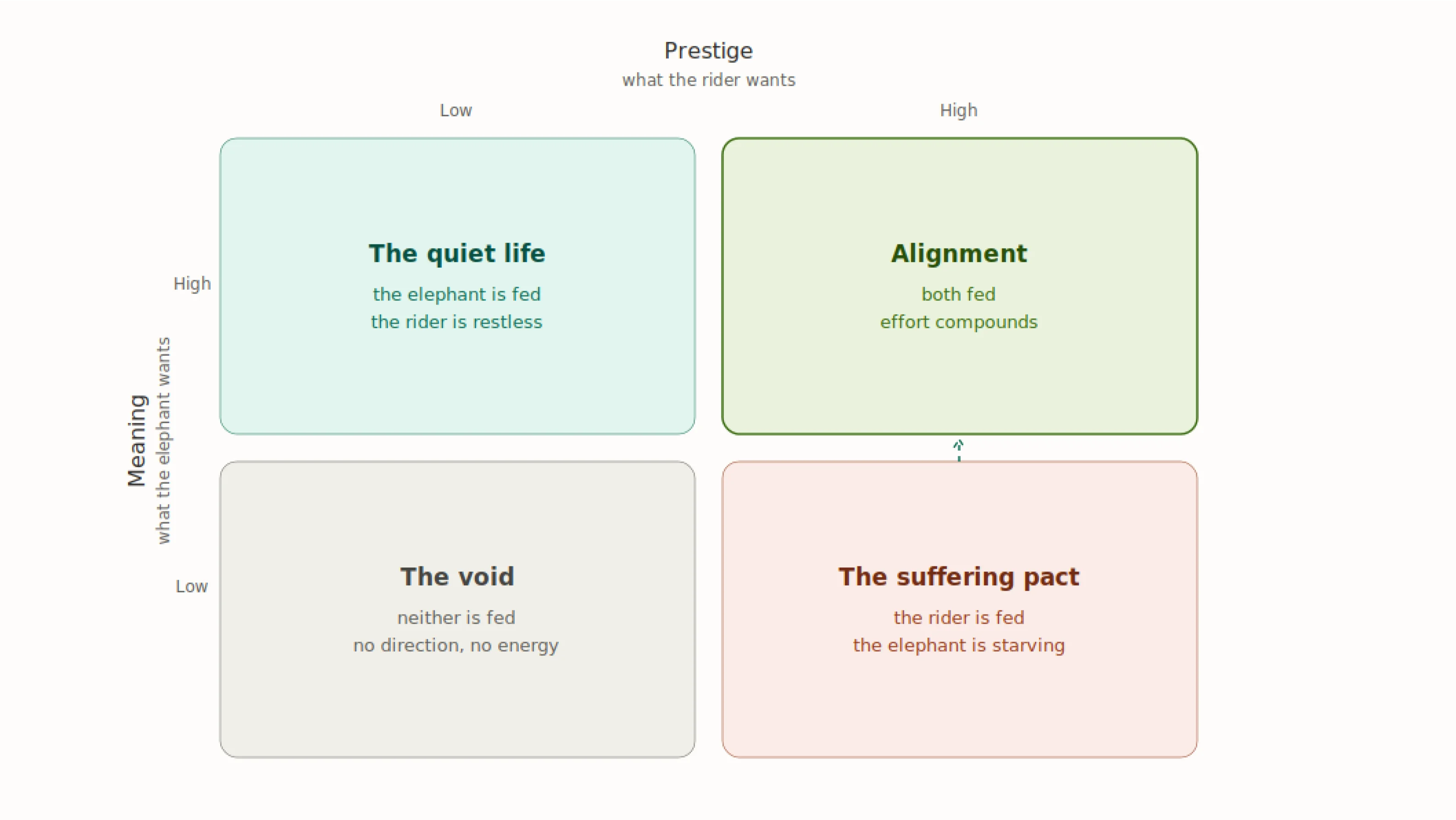
Social psychologist Jonathan Haidt uses a metaphor in The Happiness Hypothesis: the rider and the elephant. The rational mind is the rider, and the instinctual body is the elephant. They have a pact: the rider can ask the elephant to do extraordinary things, but only if the rider eventually gives the elephant the reward it was promised. The problem is that the rider and the elephant don’t want the same things.
The rider wants prestige. Titles, bonuses, board seats, the things you can screenshot and post. The elephant wants meaning. Autonomy, rest, and the felt sense that the work matters. The unlisted, illegible things that have no market price and can’t be screenshotted.
During those early years of hard work, the elephant agreed to everything the rider asked. Sleeping on airport floors, living on bread and water, and carrying the weight - the elephant said yes to all of it. It agreed because the rider promised: ek baar yeh ho jaaye, then you get what you actually want.
Your struggle was probably different from mine; maybe you fought against your parents’ wishes, maybe you came from privilege and had different battles, but the mechanism is the same.
The elephant believed the promise. It worked double shifts and pushed through the suffering. But then, instead of delivering on its promise, the rider looked up and asked, “So what’s next?”
That’s when the elephant realised it had been lied to, though not maliciously. The rider (through no fault of its own) believed its own script. The rider had been told by parents, professors and every successful person that true happiness lies in the next milestone. Ek baar shadi ho jaaye. Ek baar Series A ho jaaye. Ek baar unicorn ho jaaye.
The script always has one more step. The script never said *ab bas karo, enough.*
The Only Tool You Had
I want to be careful here because grit is not the villain in this essay. In fact, grit is why I’m writing it. The week I lived on bread and water wasn’t a tragedy. Sleeping on airport floors got me my first job in NYC. Carrying impossible expectations got me to the States and into UCLA. Building a company with limited capital led to a successful exit. The tool worked, every single time.
Your relationship to your own suffering is probably set to whatever level of resourcefulness you had the first time you encountered serious pressure. For most high performers I know, that was somewhere between ages 12 and 22. You’ve been using the same tool ever since. We call it ambition, drive, hunger, and raising the bar. We use these words because they sound like virtues, because they built everything you have. The problem is that no one teaches you when to stop using it.
Christina Maslach and Michael Leiter spent 30 years documenting something that Deci and Ryan formalised into Self-Determination Theory: misalignment of values predicts the emotional exhaustion of burnout independently of workload. You can work 30 hours a week and still be burned out if those 30 hours feed the wrong appetite. That’s what breaks the pact between the rider and the elephant. The elephant can handle the stress, but not the realisation that its years of effort were paid in a currency it never wanted.
The strength that helps you push through suffering also lets you ignore why you’re suffering. Roll didn’t realise it when he crossed the line. He kept using the pain tolerance he built as a Stanford swimmer to get through the misery of his desk job. He drank, used substances, and gained weight. By age 40, he was defeated by the staircase in his own house - a man who had swum at the highest level, now unable to climb to his second floor without stopping.
I didn’t know either. My body had already sent warnings I ignored for years: a slipped disc, a stroke, all in my twenties. The WHO says working 55 hours a week raises stroke risk by 35% above baseline. I had been working over 80 hours a week for a decade, and the grit that kept me going was also causing me damage because the elephant eventually figured out the script had no ending.
The Wrong Water
It is true that for some people, the rider and the elephant may be in sync, and this whole narrative may feel like an exaggeration. But for those who didn’t feel the exit the way you expected, or if the bonus wasn't satisfying enough, let me show you what the trap really looks like.
Imagine a man on a raft in the Pacific, surrounded by more water than he could drink in a thousand lifetimes, yet dying of thirst. Eventually, his thirst wins. He cups his hands and drinks. But seawater takes more fluid from his cells than it gives back. He gets thirstier, drinks more, and becomes even thirstier. Salt starts killing him from inside, even though it looks like survival from the outside. The wrong liquid and the right liquid are made of the same molecules. Only one of them keeps you alive. This is the trap. The reward looks almost the same as what you truly need. It comes with applause and, for a moment, feels right. But then the feeling fades, and you’re even thirstier than before, with only the same tool that made you thirsty in the first place.
Why effort and rest are not enough, and the 20 minute audit that changes everything.
Wellness advocate Rich Roll spent years walking the halls of his law firm, feeling a constant, low-level confusion. It wasn’t about the work - he was good at it. What puzzled him was that while others seemed to genuinely enjoy it, he could not say the same for himself. Still, he kept going. He had once been a world-ranked swimmer at Stanford, but by age 40, he couldn’t climb the stairs in his own house. What happened in between is the story I want to tell. But before that, I need to admit that my story is no different.
Six months after CreditVidya was acquired by CRED, I sat in a Bangalore coffee shop across from someone who asked what I would build next. It was a fair question. I had options, capital, and reputation. But suddenly, and oddly, I didn’t have an answer. It wasn’t that I didn’t know what to say, but something inside me had gone quiet in a way I had never felt before.
That quiet is what this essay is about.
For a decade, I kept telling myself the reward for my hard work was just around the corner. Ek baar MBA ho jaaye, bus life set. Ek baar acquisition ho jaaye, bus life set. The MBA happened. The acquisition happened. But the feeling I was promised never came.
The Rider and the Elephant
Social psychologist Jonathan Haidt uses a metaphor in The Happiness Hypothesis: the rider and the elephant. The rational mind is the rider, and the instinctual body is the elephant. They have a pact: the rider can ask the elephant to do extraordinary things, but only if the rider eventually gives the elephant the reward it was promised. The problem is that the rider and the elephant don’t want the same things.
The rider wants prestige. Titles, bonuses, board seats, the things you can screenshot and post. The elephant wants meaning. Autonomy, rest, and the felt sense that the work matters. The unlisted, illegible things that have no market price and can’t be screenshotted.
During those early years of hard work, the elephant agreed to everything the rider asked. Sleeping on airport floors, living on bread and water, and carrying the weight - the elephant said yes to all of it. It agreed because the rider promised: ek baar yeh ho jaaye, then you get what you actually want.
Your struggle was probably different from mine; maybe you fought against your parents’ wishes, maybe you came from privilege and had different battles, but the mechanism is the same.
The elephant believed the promise. It worked double shifts and pushed through the suffering. But then, instead of delivering on its promise, the rider looked up and asked, “So what’s next?”
That’s when the elephant realised it had been lied to, though not maliciously. The rider (through no fault of its own) believed its own script. The rider had been told by parents, professors and every successful person that true happiness lies in the next milestone. Ek baar shadi ho jaaye. Ek baar Series A ho jaaye. Ek baar unicorn ho jaaye.
The script always has one more step. The script never said *ab bas karo, enough.*
The Only Tool You Had
I want to be careful here because grit is not the villain in this essay. In fact, grit is why I’m writing it. The week I lived on bread and water wasn’t a tragedy. Sleeping on airport floors got me my first job in NYC. Carrying impossible expectations got me to the States and into UCLA. Building a company with limited capital led to a successful exit. The tool worked, every single time.
Your relationship to your own suffering is probably set to whatever level of resourcefulness you had the first time you encountered serious pressure. For most high performers I know, that was somewhere between ages 12 and 22. You’ve been using the same tool ever since. We call it ambition, drive, hunger, and raising the bar. We use these words because they sound like virtues, because they built everything you have. The problem is that no one teaches you when to stop using it.
Christina Maslach and Michael Leiter spent 30 years documenting something that Deci and Ryan formalised into Self-Determination Theory: misalignment of values predicts the emotional exhaustion of burnout independently of workload. You can work 30 hours a week and still be burned out if those 30 hours feed the wrong appetite. That’s what breaks the pact between the rider and the elephant. The elephant can handle the stress, but not the realisation that its years of effort were paid in a currency it never wanted.
The strength that helps you push through suffering also lets you ignore why you’re suffering. Roll didn’t realise it when he crossed the line. He kept using the pain tolerance he built as a Stanford swimmer to get through the misery of his desk job. He drank, used substances, and gained weight. By age 40, he was defeated by the staircase in his own house - a man who had swum at the highest level, now unable to climb to his second floor without stopping.
I didn’t know either. My body had already sent warnings I ignored for years: a slipped disc, a stroke, all in my twenties. The WHO says working 55 hours a week raises stroke risk by 35% above baseline. I had been working over 80 hours a week for a decade, and the grit that kept me going was also causing me damage because the elephant eventually figured out the script had no ending.
The Wrong Water
It is true that for some people, the rider and the elephant may be in sync, and this whole narrative may feel like an exaggeration. But for those who didn’t feel the exit the way you expected, or if the bonus wasn't satisfying enough, let me show you what the trap really looks like.
Imagine a man on a raft in the Pacific, surrounded by more water than he could drink in a thousand lifetimes, yet dying of thirst. Eventually, his thirst wins. He cups his hands and drinks. But seawater takes more fluid from his cells than it gives back. He gets thirstier, drinks more, and becomes even thirstier. Salt starts killing him from inside, even though it looks like survival from the outside. The wrong liquid and the right liquid are made of the same molecules. Only one of them keeps you alive. This is the trap. The reward looks almost the same as what you truly need. It comes with applause and, for a moment, feels right. But then the feeling fades, and you’re even thirstier than before, with only the same tool that made you thirsty in the first place.
When Success Still Feels Empty
Why effort and rest are not enough, and the 20 minute audit that changes everything.
Wellness advocate Rich Roll spent years walking the halls of his law firm, feeling a constant, low-level confusion. It wasn’t about the work - he was good at it. What puzzled him was that while others seemed to genuinely enjoy it, he could not say the same for himself. Still, he kept going. He had once been a world-ranked swimmer at Stanford, but by age 40, he couldn’t climb the stairs in his own house. What happened in between is the story I want to tell. But before that, I need to admit that my story is no different.
Six months after CreditVidya was acquired by CRED, I sat in a Bangalore coffee shop across from someone who asked what I would build next. It was a fair question. I had options, capital, and reputation. But suddenly, and oddly, I didn’t have an answer. It wasn’t that I didn’t know what to say, but something inside me had gone quiet in a way I had never felt before.
That quiet is what this essay is about.
For a decade, I kept telling myself the reward for my hard work was just around the corner. Ek baar MBA ho jaaye, bus life set. Ek baar acquisition ho jaaye, bus life set. The MBA happened. The acquisition happened. But the feeling I was promised never came.
The Rider and the Elephant
Social psychologist Jonathan Haidt uses a metaphor in The Happiness Hypothesis: the rider and the elephant. The rational mind is the rider, and the instinctual body is the elephant. They have a pact: the rider can ask the elephant to do extraordinary things, but only if the rider eventually gives the elephant the reward it was promised. The problem is that the rider and the elephant don’t want the same things.
The rider wants prestige. Titles, bonuses, board seats, the things you can screenshot and post. The elephant wants meaning. Autonomy, rest, and the felt sense that the work matters. The unlisted, illegible things that have no market price and can’t be screenshotted.
During those early years of hard work, the elephant agreed to everything the rider asked. Sleeping on airport floors, living on bread and water, and carrying the weight - the elephant said yes to all of it. It agreed because the rider promised: ek baar yeh ho jaaye, then you get what you actually want.
Your struggle was probably different from mine; maybe you fought against your parents’ wishes, maybe you came from privilege and had different battles, but the mechanism is the same.
The elephant believed the promise. It worked double shifts and pushed through the suffering. But then, instead of delivering on its promise, the rider looked up and asked, “So what’s next?”
That’s when the elephant realised it had been lied to, though not maliciously. The rider (through no fault of its own) believed its own script. The rider had been told by parents, professors and every successful person that true happiness lies in the next milestone. Ek baar shadi ho jaaye. Ek baar Series A ho jaaye. Ek baar unicorn ho jaaye.
The script always has one more step. The script never said *ab bas karo, enough.*
The Only Tool You Had
I want to be careful here because grit is not the villain in this essay. In fact, grit is why I’m writing it. The week I lived on bread and water wasn’t a tragedy. Sleeping on airport floors got me my first job in NYC. Carrying impossible expectations got me to the States and into UCLA. Building a company with limited capital led to a successful exit. The tool worked, every single time.
Your relationship to your own suffering is probably set to whatever level of resourcefulness you had the first time you encountered serious pressure. For most high performers I know, that was somewhere between ages 12 and 22. You’ve been using the same tool ever since. We call it ambition, drive, hunger, and raising the bar. We use these words because they sound like virtues, because they built everything you have. The problem is that no one teaches you when to stop using it.
Christina Maslach and Michael Leiter spent 30 years documenting something that Deci and Ryan formalised into Self-Determination Theory: misalignment of values predicts the emotional exhaustion of burnout independently of workload. You can work 30 hours a week and still be burned out if those 30 hours feed the wrong appetite. That’s what breaks the pact between the rider and the elephant. The elephant can handle the stress, but not the realisation that its years of effort were paid in a currency it never wanted.
The strength that helps you push through suffering also lets you ignore why you’re suffering. Roll didn’t realise it when he crossed the line. He kept using the pain tolerance he built as a Stanford swimmer to get through the misery of his desk job. He drank, used substances, and gained weight. By age 40, he was defeated by the staircase in his own house - a man who had swum at the highest level, now unable to climb to his second floor without stopping.
I didn’t know either. My body had already sent warnings I ignored for years: a slipped disc, a stroke, all in my twenties. The WHO says working 55 hours a week raises stroke risk by 35% above baseline. I had been working over 80 hours a week for a decade, and the grit that kept me going was also causing me damage because the elephant eventually figured out the script had no ending.
The Wrong Water
It is true that for some people, the rider and the elephant may be in sync, and this whole narrative may feel like an exaggeration. But for those who didn’t feel the exit the way you expected, or if the bonus wasn't satisfying enough, let me show you what the trap really looks like.
Imagine a man on a raft in the Pacific, surrounded by more water than he could drink in a thousand lifetimes, yet dying of thirst. Eventually, his thirst wins. He cups his hands and drinks. But seawater takes more fluid from his cells than it gives back. He gets thirstier, drinks more, and becomes even thirstier. Salt starts killing him from inside, even though it looks like survival from the outside. The wrong liquid and the right liquid are made of the same molecules. Only one of them keeps you alive. This is the trap. The reward looks almost the same as what you truly need. It comes with applause and, for a moment, feels right. But then the feeling fades, and you’re even thirstier than before, with only the same tool that made you thirsty in the first place.

Resonating with this philosophy?
Join the smartest founders mastering the inner game to face the unknown. Read by YC & Sequoia.

The Loop
The misalignment isn’t a one-time mistake; it’s a loop. The reward arrives, but the elephant remains unsatisfied. Instead of looking into why, which would mean sitting still and feeling something, the rider prescribes more of the same solution, just at a higher dose.
Kahneman and Deaton found that emotional well-being levels off at about $75,000 in household income. Beyond that, daily life doesn’t really improve with more money. But the rider’s ledger - the way we measure our lives - keeps building up with income. The rider keeps pushing for the next raise, even as the elephant grows quieter. By now, the elephant has mostly stopped sending signals.
This is why someone can get a seven-figure bonus and still feel cheated that it wasn’t bigger. They aren’t lying when they say the bonus made them happy - they’re just talking about the rider’s ledger, not the elephant’s. I know this loop. I lived it for seven years.
The higher the compensation, the tighter the golden handcuffs become. The cost of leaving keeps growing. The rider needs to believe that this version of the role, this year, or this deal will finally deliver the reward the elephant was promised.
The Third Lever
B.K.S. Iyengar spent sixty years teaching people how to stand in Tadasana, or mountain pose. To most people, it just looks like standing still. But what he was really teaching was alignment: feet rooted, knees over ankles, pelvis neutral, spine long. When you’re aligned, you can hold the pose for an hour and feel lighter at the end than when you started. If you’re misaligned, five minutes can ruin your lower back.
Iyengar’s main lesson, repeated in all his writings, is that effort without alignment leads to injury. The harder you push in a misaligned pose, the more you hurt yourself. Students who came to him in pain were rarely lazy - they were just trying too hard in the wrong way.
I spent two decades convinced there were only two levers: discipline and rest. Push harder, or recover more. If you’re exhausted, the problem must be one of those two dials. Turn one up. Turn the other down. Try again.
There’s a third lever, but no one taught us its name.
The reason for the exhaustion, the emptiness, the hollowness: it is not that you didn’t work hard enough. It is not that you didn’t rest enough. It is not that the rider shouldn’t have made the promise. The rider was doing its job. The elephant was doing its job. Both were running exactly the programme they were trained to run.
The answer was never to grip harder or to put in less effort. The answer was alignment - to find the adjustment that lets the same effort create depth instead of damage. Aligned effort compounds. Misaligned effort accumulates.
A 2018 BetterUp survey found that nine out of ten workers would trade part of their income for more meaningful work, on average, twenty-three per cent of their future earnings. People already know their rider is spending in the wrong currency. What they don’t know is how to stop.
What the Work Is For
The way out does not begin with quitting. It does not begin with a sabbatical. It begins, according to Tasha Eurich’s self-awareness research, with something so unglamorous it sounds like a joke: an audit. Twenty minutes, this week, with a piece of paper and a pen. List every decision in your work. Mark each one A (you actually control this), B (you appear to control this, but in practice the system makes the decision for you), or C (someone else controls this and you have been pretending otherwise).
The list will reveal that the autonomy you have been telling the elephant you possess is mostly fictional - the thing the elephant has been complaining about all along. The audit will not ask you to work less. It will not ask you to want less. It will just point out the missing entry in the balance sheet.
Naming that gap doesn’t fix everything by itself. But it is the first honest sip of fresh water - the first thing in a long time that the elephant recognises as the right liquid.
For a time, Andre Agassi was the best tennis player in the world. He also hated tennis - not just in the tired way athletes sometimes mention, but deep down. "I play tennis for a living," he wrote, "even though I hate tennis." He didn’t quit. Instead, he built a school for children in Las Vegas and decided tennis was just the vehicle, not the destination. The sport stopped being the reward and became the way to create a reward that the elephant could accept.
In 1998, John Wood was Microsoft’s Director of Business Development for Greater China, leading the company’s fastest-growing product. During a trekking holiday in Nepal, he visited a village school with almost no books. Reflecting on his life, he described it in a sentence I’ll never forget: I had adopted the commando lifestyle of a corporate warrior. Vacation was for people who were soft. That’s the rider’s voice, captured perfectly. Wood left Microsoft and started Room to Read, which now operates in ten countries, has opened thousands of libraries, and has put books in the hands of millions of children.
Agassi stayed in the pose and changed what it was for. Wood left the pose entirely and built a new one. Both are vertical moves. Neither is the same as quitting.
My own solution is still a work in progress. I’m trying what I call a portfolio life: some days I write, some days I advise founders, some days I teach, and some days I do nothing at all - which is still the hardest part. The common thread is that I’m trying, imperfectly, to pay my elephant in its own currency, bit by bit, while the rider learns a new language.
It isn’t going smoothly. Old habits keep coming back - the urge to scale, to monetise, to turn quiet moments into metrics. Every week, I notice the rider trying to take over the practice. Every week, I start again.
The Pose You’re Actually In
To arrive at a balanced pose, the rider has to come down to the elephant’s level and listen. The elephant has to trust that the listening is genuine. Together, slowly and imperfectly, they have to build a new chemistry - one that the body can actually sustain.
No book or essay can teach you that. But the audit takes just twenty minutes, and the alignment that follows can last a lifetime. It is not glamorous, but it is the only arrangement I know of that does not leave you thirstier than you started.
Choose your audit words wisely, for if years were letters, the average human lifespan would not be longer than this sentence.

To be continued…
A small favor...
I don't run ads. If this brought clarity, the biggest favor you can do is subscribe below.


.webp)
.svg)

.svg)