
The Hidden Cost of Not Choosing Yourself

For a majority of us, life is something that happens to us, not something we choose. That’s common knowledge, but there’s an irony to it. Unlike The Matrix, we humans, not machines, have created a simulated world for ourselves, and are living it too, believing what happens to us is what we chose.
I was reminded of this, sitting at Bokka Coffee one morning, clouding my life away in gym clothes, when the man next to me leaned over and asked what I was ‘building’. He assumed gym clothes meant gym brain. He was wrong, but curious. So we got talking. I told him about my tryst with yoga, the motorcycle year, and the writing. He runs a software services company. By every measure, he is successful. But his face said something different. He wants something more. He wants to build with AI this time, to feel again the thing that made him start a company in the first place. Instead, he has client meetings - to sustain a business that works and a life that doesn't quite.
I asked him if building again would settle things. He didn't have a clean answer. What he had was a laugh, a little tired around the edges, and this: he envied me for showing the courage to live my life. He said he couldn't imagine walking around Bombay in gym clothes. I told him I couldn't imagine going back to a formal shirt. We were joking. But we weren't.
Here is what I took from that conversation: the more successful you become, the harder it is to leave. Not because there’s comfort around, but because we confuse success with life itself.
I know that confusion from the inside. By the time CreditVidya was acquired by CRED, I had stopped being a person who ran a company. I had become it. The exit should have felt like an arrival. Instead, I sat in a coffee shop in Bangalore feeling like a failure, scanning the horizon for the next thing that might tell me who I was. It took me a year on a motorcycle and a lot of silence to understand that the self I was looking for was never going to be found in a milestone. This essay is my explanation to my coffee shop friend.

When You Become Your Output
Sachin Tendulkar picked up a cricket bat at 7, and something in him recognised itself. But for the majority of us, a series of reasonable decisions, each one sensible in isolation, add up over the years to a life we didn't quite choose. Physician and author Gabor Maté puts it plainly: when a child must choose between attachment and authenticity, attachment wins every time. You cannot fire your parents. You cannot quit your origin. So before you know what you want, you learn to fit in. And then it compounds. You grow up and take the job that makes sense. You pile up promotions, recognitions, and responsibilities. That pile, built achievement by achievement, then stops being a record of what you did and becomes the answer to who you are.
I watched this happen to me, and I could not stop it. The slow, invisible merger of the self with the output happens until you can no longer tell where one ends and the other begins. At that point, you don't feel achievements anymore. You are the achievement. And the moment that happens, quitting stops being a career decision. It becomes self-erasure. Which is why the most successful people are often the most trapped. The suit fits best the founder who has won, and it tightens, almost imperceptibly, with every milestone year after year until you forget there was another version of you as well.
The Cost of the False Self
At some point - and you probably can't remember exactly when - you stop asking what you want and start asking what is expected. You make one adjustment. Then another. Then the adjustments became the self.
Psychoanalyst D.W. Winnicott had a name for this. He called it the False Self, which is not a fake self, but a functional one - built early to manage the world's expectations so that you could fit in. As Maté observed, we choose attachment every single time. So you trade your authenticity for the right to stay in the room, and then you stay so long you forget having made a compromise.
Author Min Jin Lee arrived in the United States from Korea as a seven-year-old. She did what the immigrant arithmetic demanded: Georgetown Law, then a commercial firm in New York, then a work schedule that translated to roughly a hundred hours a week. Two years in, she was sitting in a partner's office when he handed her another massive file. Her body, by then, had been sending invoices for months: a severe liver disease, exacerbated by malnutrition and the sustained physiology of a life performed on schedule. She heard herself say: I quit. I can't do this anymore.
Career satisfaction, according to Clark, Oswald and Warr's research across decades and countries, follows a U-shaped curve: it falls steadily from early career and hits its lowest point in the mid-forties to mid-fifties. Exactly when the suit fits best. Exactly when the income is highest. Exactly when the cost of leaving feels most unacceptable. What most people don't see is that the False Self extracts a physical price. The chronic stress of performing a life you didn't choose doesn't stay in the mind. It moves into the body. For Min Jin Lee it was a severe liver disease. For me, it was a slipped disc. Then a stroke. But the deeper cost is harder to name than a diagnosis. It is the life unlived. My friend at Bokka carried it on his face without knowing it. He had hit every marker anyone had ever given him. What he couldn't articulate yet was his own.
For a majority of us, life is something that happens to us, not something we choose. That’s common knowledge, but there’s an irony to it. Unlike The Matrix, we humans, not machines, have created a simulated world for ourselves, and are living it too, believing what happens to us is what we chose.
I was reminded of this, sitting at Bokka Coffee one morning, clouding my life away in gym clothes, when the man next to me leaned over and asked what I was ‘building’. He assumed gym clothes meant gym brain. He was wrong, but curious. So we got talking. I told him about my tryst with yoga, the motorcycle year, and the writing. He runs a software services company. By every measure, he is successful. But his face said something different. He wants something more. He wants to build with AI this time, to feel again the thing that made him start a company in the first place. Instead, he has client meetings - to sustain a business that works and a life that doesn't quite.
I asked him if building again would settle things. He didn't have a clean answer. What he had was a laugh, a little tired around the edges, and this: he envied me for showing the courage to live my life. He said he couldn't imagine walking around Bombay in gym clothes. I told him I couldn't imagine going back to a formal shirt. We were joking. But we weren't.
Here is what I took from that conversation: the more successful you become, the harder it is to leave. Not because there’s comfort around, but because we confuse success with life itself.
I know that confusion from the inside. By the time CreditVidya was acquired by CRED, I had stopped being a person who ran a company. I had become it. The exit should have felt like an arrival. Instead, I sat in a coffee shop in Bangalore feeling like a failure, scanning the horizon for the next thing that might tell me who I was. It took me a year on a motorcycle and a lot of silence to understand that the self I was looking for was never going to be found in a milestone. This essay is my explanation to my coffee shop friend.
When You Become Your Output
Sachin Tendulkar picked up a cricket bat at 7, and something in him recognised itself. But for the majority of us, a series of reasonable decisions, each one sensible in isolation, add up over the years to a life we didn't quite choose. Physician and author Gabor Maté puts it plainly: when a child must choose between attachment and authenticity, attachment wins every time. You cannot fire your parents. You cannot quit your origin. So before you know what you want, you learn to fit in. And then it compounds. You grow up and take the job that makes sense. You pile up promotions, recognitions, and responsibilities. That pile, built achievement by achievement, then stops being a record of what you did and becomes the answer to who you are.
I watched this happen to me, and I could not stop it. The slow, invisible merger of the self with the output happens until you can no longer tell where one ends and the other begins. At that point, you don't feel achievements anymore. You are the achievement. And the moment that happens, quitting stops being a career decision. It becomes self-erasure. Which is why the most successful people are often the most trapped. The suit fits best the founder who has won, and it tightens, almost imperceptibly, with every milestone year after year until you forget there was another version of you as well.
The Cost of the False Self
At some point - and you probably can't remember exactly when - you stop asking what you want and start asking what is expected. You make one adjustment. Then another. Then the adjustments became the self.
Psychoanalyst D.W. Winnicott had a name for this. He called it the False Self, which is not a fake self, but a functional one - built early to manage the world's expectations so that you could fit in. As Maté observed, we choose attachment every single time. So you trade your authenticity for the right to stay in the room, and then you stay so long you forget having made a compromise.
Author Min Jin Lee arrived in the United States from Korea as a seven-year-old. She did what the immigrant arithmetic demanded: Georgetown Law, then a commercial firm in New York, then a work schedule that translated to roughly a hundred hours a week. Two years in, she was sitting in a partner's office when he handed her another massive file. Her body, by then, had been sending invoices for months: a severe liver disease, exacerbated by malnutrition and the sustained physiology of a life performed on schedule. She heard herself say: I quit. I can't do this anymore.
Career satisfaction, according to Clark, Oswald and Warr's research across decades and countries, follows a U-shaped curve: it falls steadily from early career and hits its lowest point in the mid-forties to mid-fifties. Exactly when the suit fits best. Exactly when the income is highest. Exactly when the cost of leaving feels most unacceptable. What most people don't see is that the False Self extracts a physical price. The chronic stress of performing a life you didn't choose doesn't stay in the mind. It moves into the body. For Min Jin Lee it was a severe liver disease. For me, it was a slipped disc. Then a stroke. But the deeper cost is harder to name than a diagnosis. It is the life unlived. My friend at Bokka carried it on his face without knowing it. He had hit every marker anyone had ever given him. What he couldn't articulate yet was his own.
The Hidden Cost of Not Choosing Yourself
For a majority of us, life is something that happens to us, not something we choose. That’s common knowledge, but there’s an irony to it. Unlike The Matrix, we humans, not machines, have created a simulated world for ourselves, and are living it too, believing what happens to us is what we chose.
I was reminded of this, sitting at Bokka Coffee one morning, clouding my life away in gym clothes, when the man next to me leaned over and asked what I was ‘building’. He assumed gym clothes meant gym brain. He was wrong, but curious. So we got talking. I told him about my tryst with yoga, the motorcycle year, and the writing. He runs a software services company. By every measure, he is successful. But his face said something different. He wants something more. He wants to build with AI this time, to feel again the thing that made him start a company in the first place. Instead, he has client meetings - to sustain a business that works and a life that doesn't quite.
I asked him if building again would settle things. He didn't have a clean answer. What he had was a laugh, a little tired around the edges, and this: he envied me for showing the courage to live my life. He said he couldn't imagine walking around Bombay in gym clothes. I told him I couldn't imagine going back to a formal shirt. We were joking. But we weren't.
Here is what I took from that conversation: the more successful you become, the harder it is to leave. Not because there’s comfort around, but because we confuse success with life itself.
I know that confusion from the inside. By the time CreditVidya was acquired by CRED, I had stopped being a person who ran a company. I had become it. The exit should have felt like an arrival. Instead, I sat in a coffee shop in Bangalore feeling like a failure, scanning the horizon for the next thing that might tell me who I was. It took me a year on a motorcycle and a lot of silence to understand that the self I was looking for was never going to be found in a milestone. This essay is my explanation to my coffee shop friend.
When You Become Your Output
Sachin Tendulkar picked up a cricket bat at 7, and something in him recognised itself. But for the majority of us, a series of reasonable decisions, each one sensible in isolation, add up over the years to a life we didn't quite choose. Physician and author Gabor Maté puts it plainly: when a child must choose between attachment and authenticity, attachment wins every time. You cannot fire your parents. You cannot quit your origin. So before you know what you want, you learn to fit in. And then it compounds. You grow up and take the job that makes sense. You pile up promotions, recognitions, and responsibilities. That pile, built achievement by achievement, then stops being a record of what you did and becomes the answer to who you are.
I watched this happen to me, and I could not stop it. The slow, invisible merger of the self with the output happens until you can no longer tell where one ends and the other begins. At that point, you don't feel achievements anymore. You are the achievement. And the moment that happens, quitting stops being a career decision. It becomes self-erasure. Which is why the most successful people are often the most trapped. The suit fits best the founder who has won, and it tightens, almost imperceptibly, with every milestone year after year until you forget there was another version of you as well.
The Cost of the False Self
At some point - and you probably can't remember exactly when - you stop asking what you want and start asking what is expected. You make one adjustment. Then another. Then the adjustments became the self.
Psychoanalyst D.W. Winnicott had a name for this. He called it the False Self, which is not a fake self, but a functional one - built early to manage the world's expectations so that you could fit in. As Maté observed, we choose attachment every single time. So you trade your authenticity for the right to stay in the room, and then you stay so long you forget having made a compromise.
Author Min Jin Lee arrived in the United States from Korea as a seven-year-old. She did what the immigrant arithmetic demanded: Georgetown Law, then a commercial firm in New York, then a work schedule that translated to roughly a hundred hours a week. Two years in, she was sitting in a partner's office when he handed her another massive file. Her body, by then, had been sending invoices for months: a severe liver disease, exacerbated by malnutrition and the sustained physiology of a life performed on schedule. She heard herself say: I quit. I can't do this anymore.
Career satisfaction, according to Clark, Oswald and Warr's research across decades and countries, follows a U-shaped curve: it falls steadily from early career and hits its lowest point in the mid-forties to mid-fifties. Exactly when the suit fits best. Exactly when the income is highest. Exactly when the cost of leaving feels most unacceptable. What most people don't see is that the False Self extracts a physical price. The chronic stress of performing a life you didn't choose doesn't stay in the mind. It moves into the body. For Min Jin Lee it was a severe liver disease. For me, it was a slipped disc. Then a stroke. But the deeper cost is harder to name than a diagnosis. It is the life unlived. My friend at Bokka carried it on his face without knowing it. He had hit every marker anyone had ever given him. What he couldn't articulate yet was his own.

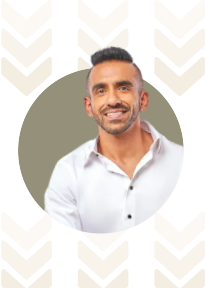
Resonating with this philosophy?
Join the smartest founders mastering the inner game to face the unknown. Read by YC & Sequoia.
Maybe Luck. Maybe Adversity
Ken Jeong spent seven years as a practicing physician while moonlighting in comedy clubs at night. The career satisfied every external metric of a life well lived. His family had prayed for a doctor. He had become one. He stayed the way most people stay: not by deciding to, but by not deciding not to. What broke the fusion was not ambition. It was his wife’s cancer diagnosis. Her mortality made his own invisible goal suddenly visible. The risk he had spent years avoiding - leaving medicine, looking foolish, becoming a beginner at forty - looked, in the clean bright light of her illness, like nothing at all.
But you don't always need a crisis. Sometimes the suit just slips in an ordinary moment, and you catch a glimpse of what is underneath.
Ali Abdaal spent years as a Cambridge-trained NHS doctor while building one of the world's most successful YouTube channels on the side. He told himself the channel was a hobby, that the degree was the real thing, that leaving would be irresponsible. Then one day on a hospital ward, a patient ignored the senior consultant and looked directly at Abdaal - recognising him from YouTube. The cover story collapsed in a corridor. What he realised, later, was not just that his impact had moved. It was that his identity had been split in two for years, and the cost of maintaining both halves was being paid somewhere he couldn't see on a spreadsheet.
He contacted the UK General Medical Council and formally requested that his medical license be withdrawn. He didn't just leave medicine. He burned the return ticket as well. He understood what research confirms: the False Self does not release you gradually. You have to name it and act.
You can wait for serendipity. You can wait for adversity to force your hand the way it forced Ken Jeong's. Or you can decide - before the diagnosis, before the crisis, before the body sends the invoice - that the cost of not living your own life is already too high.
So, before the motorcycle, before the yoga, before I found the courage to build a life I actually chose, I did this. You may try as well.
One Experiment. Three Questions
For one day this weekend, wear your oldest, most ordinary clothes. Not the shirt that does the speaking for you. Go to a coffee shop. Walk around your neighbourhood. Notice how people treat you and how you feel about it.
That feeling - somewhere between being exposed and grounded - is information. It is showing you how much of who you are has been borrowed from what you own and what your business card says. It is showing you what remains when you take it away.
Now sit with these three questions.
The first: What is the number? The exact amount - the salary, the valuation, the savings - that would finally make you feel safe enough to try something different. Write it down. Then ask yourself why the number you already have has not made you feel that way. Because it hasn't. That's why you're reading this.
The second: The next time you say yes to something this week - a meeting, a project - stop for one moment. Notice what arrives in your body. Is it relief? Or is it emptiness? Relief means you chose it. Emptiness means the suit chose it for you.
The third: Who gave you this goal? Not the company goal. This one. The life you are living right now. Name the person, or the moment, or the fear that handed it to you. Because if you can name who gave it to you, you can finally ask whether you ever actually chose it for yourself.
The Person Who Was Always There
The suit kept you alive. I mean it without irony. It was the right tool for a specific moment: the credential that got you in the door, the discipline that built the company, the reliability that earned the trust. Honour it for that. It did its job.
But there is a difference between a tool and an identity. And at some point - only you know when - the tool stops serving you and starts running you.
I think about my friend at Bokka often. The laugh that was a little tired around the edges. The ironed shirt. The life that was happening to him while he sat inside it. He had done everything right. What he hadn't yet done was the hardest thing: decide that the life he was living was a choice he was still making - and that he could make a different one.
Life does not have to happen to you. But the fact remains that the more successful you become, the harder it becomes to take off the suit of ‘success’. It isn't. You stitched the suit. Which means you can also, slowly and deliberately, alter it.
The person you were before the first pitch deck, before the EMI, before achievement became the answer to every question about who you are - that person didn't disappear, but is waiting for you to find the courage to ask the question you have been avoiding.
What would you build if you were building it for yourself?

To be continued…
A small favor...
I don't run ads. If this brought clarity, the biggest favor you can do is subscribe below.


.svg)

.svg)